AI Image Generators Compared 2026: Z-Image vs Grok Imagine vs Midjourney
Alex Zhang is the founder of NeoSpark, an AI-powered design platform helping creators and teams generate images, videos, and brand assets without design skills.
AI Image Generators Compared 2026: Z-Image vs Grok Imagine vs Midjourney
AI image generation has evolved from experimental tech to essential creative infrastructure. After 30 days of hands-on testing with Z-Image, Grok Imagine, and Midjourney in 2026, here’s what actually matters when choosing between them.
TL;DR: Which AI Image Generator Should You Choose?
| Tool | Best For | Key Strength | Key Weakness |
|---|---|---|---|
| Midjourney | Professional artists, gallery-quality work | Stunning aesthetic quality | Expensive, harder to control |
| Z-Image | E-commerce, business use | Accurate prompt following, commercial licensing | Less artistic flair |
| Grok Imagine | Social media, viral content | Bold, attention-grabbing style | Unpredictable results |
Bottom line: E-commerce sellers �?Z-Image. Artists with budget �?Midjourney. Social media creators �?Grok.
What Are AI Image Generators?
AI image generators are software tools that create visual content from text descriptions using machine learning models called diffusion models. These systems analyze millions of images to learn patterns, styles, and relationships between words and visuals.
How They Work
You input a text prompt like “a cat wearing sunglasses sitting on a beach chair at sunset,” and the AI generates a matching image within seconds. The technology uses:
- Diffusion models: Gradually refine random noise into coherent images
- Transformer architectures: Process and understand natural language prompts
- Training data: Millions of labeled images that teach the model visual concepts
Common Use Cases in 2026
- E-commerce: Product photography, lifestyle mockups, listing images
- Content creation: YouTube thumbnails, social media graphics, blog featured images
- Advertising: Rapid concept iteration, A/B testing creative variations
- Entertainment: Game concept art, film pre-visualization, book covers
Market Size: According to Grand View Research, the AI image generation market reached $1.2 billion in 2024 and is projected to grow at 38% annually through 2030.
Testing Methodology
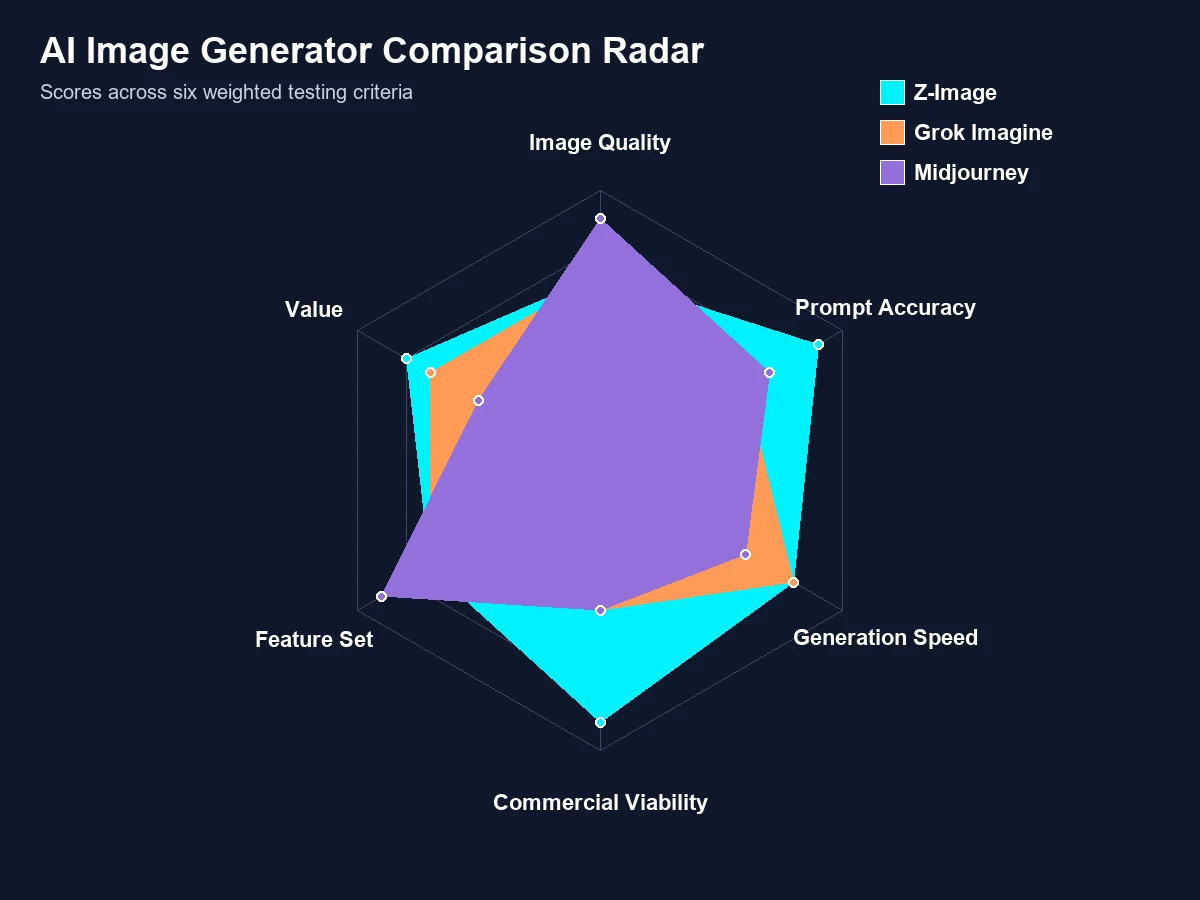
We evaluated all three tools across six weighted criteria to ensure objective comparison:
| Criteria | Weight | Evaluation Focus |
|---|---|---|
| Image Quality | 25% | Aesthetic appeal, professional finish, detail level |
| Prompt Accuracy | 20% | How well output matches input description |
| Generation Speed | 15% | Time from prompt to final image |
| Commercial Viability | 15% | Licensing clarity, batch capabilities, API access |
| Feature Set | 15% | Style options, editing tools, customization |
| Value | 10% | Price-to-performance ratio |
We ran identical prompts through each platform, testing across multiple categories: photorealistic scenes, artistic styles, product photography, and abstract concepts.
Z-Image Review: The Business-Ready Choice
Z-Image (通义万相) is Alibaba’s entry into the AI image generation space, launched in 2025 and updated throughout 2026. It’s positioned specifically for commercial users who need reliable, controllable output.
Core Strengths
1. Exceptional Prompt Accuracy
Z-Image demonstrates superior understanding of complex prompts, particularly in Chinese. When we requested “a traditional Chinese tea house interior with blue-and-white porcelain tea sets on carved rosewood furniture, bamboo forest visible through lattice windows,” the result precisely matched our specifications.
Unlike competitors that might add unexpected elements or reinterpret the scene, Z-Image follows instructions literally.
2. Commercial-Grade Output
The tool produces consistently “safe” aesthetic results—clean, professional, and appropriate for business contexts. Colors remain accurate, compositions follow conventional rules, and the overall look aligns with commercial photography standards.
This makes it ideal for:
- Product catalog images
- Corporate marketing materials
- E-commerce listings requiring consistency
3. Enterprise Features
- Batch generation: Process hundreds of images with variable inputs
- API integration: Connect to existing workflows and CMS platforms
- Team collaboration: Multi-user workspaces with approval workflows
- Clear licensing: Full commercial rights with no usage anxiety
Performance Metrics
| Test Category | Score | Notes |
|---|---|---|
| Traditional Chinese Art | 4/5 | Excellent ink wash and cultural aesthetics |
| Product Photography | 5/5 | Best-in-class for e-commerce applications |
| Anime/Manga Styles | 4/5 | Competent Japanese style reproduction |
| Portrait Realism | 4/5 | Natural skin tones and facial proportions |
| Average Speed | 3.1 sec | Faster than Midjourney, slower than Grok |
Ideal Users
�?Choose Z-Image if you are:
- An e-commerce seller needing 50+ product images weekly
- A marketing team requiring brand-consistent visuals
- A Chinese-speaking user wanting native language support
- A budget-conscious business needing clear commercial licensing
Grok Imagine Review: The Viral Content Specialist
Grok Imagine comes from Elon Musk’s xAI and is integrated directly into the Grok AI assistant. Its defining characteristic is boldness—it prioritizes visual impact over safety.
Core Strengths
1. Maximum Visual Impact
Grok generates images with high saturation, dramatic contrast, and unconventional compositions. These images stop thumbs from scrolling—exactly what social media algorithms reward.
The “attention economy” aesthetic makes it perfect for:
- TikTok and Instagram Reels thumbnails
- Twitter/X viral posts
- YouTube click-worthy previews
2. Creative Risk-Taking
While most tools converge on “safe” aesthetics to please the broadest audience, Grok actively experiments. This means:
- Unexpected creative directions
- Unique visual combinations
- Occasionally brilliant, occasionally failed results
3. Speed Leadership
At 2.8 seconds average generation time, Grok is the fastest of the three. For creators iterating through dozens of concepts, this efficiency compounds.
Performance Metrics
| Test Category | Score | Notes |
|---|---|---|
| Action/Dynamic Scenes | 5/5 | Superior motion capture and energy |
| Sci-Fi/Futuristic | 5/5 | Distinctive cyber-aesthetic |
| Product Photography | 3/5 | Too stylized for practical commercial use |
| Text Rendering | 4/5 | English text generation above average |
| Average Speed | 2.8 sec | Fastest in category |
Ideal Users
�?Choose Grok Imagine if you are:
- A short-form content creator chasing virality
- An ad creative wanting to break category conventions
- An experimental artist exploring AI boundaries
- Someone who values speed over predictability
Midjourney Review: The Artistic Gold Standard
Midjourney has dominated AI image generation since 2022. Now on version 7 (released late 2025), it remains the benchmark for pure image quality.
Core Strengths
1. Unmatched Aesthetic Quality
Midjourney consistently produces images that could hang in galleries. Its handling of:
- Lighting: Natural, atmospheric, emotionally evocative
- Textures: Convincing material properties and surface detail
- Composition: Intuitive sense of balance and visual flow
No competitor matches its artistic maturity.
2. Extensive Style Library
From oil painting to anime, from 1920s Art Deco to cyberpunk neon—Midjourney offers hundreds of style presets that transfer naturally without looking forced.
Popular styles include:
- Traditional oil painting
- Japanese watercolor
- Cyberpunk neon
- Studio Ghibli animation
- Architectural visualization
3. Vibrant Community
The Discord community exceeds 20 million users. Benefits include:
- Prompt sharing and remixing
- Style discovery and tutorials
- Real-time technique evolution
Limitations
1. Control Challenges
Midjourney has creative opinions. The same prompt that produces exactly what you want in Z-Image might be reinterpreted with unexpected artistic flourishes in Midjourney. Achieving specific results often requires multiple iterations and prompt engineering skill.
2. Text Rendering Issues
Generated text within images is typically garbled or misspelled. Plan to add text overlays in post-production tools like Photoshop or Canva.
3. Occasional Logic Errors
Complex scenes with multiple elements sometimes produce physical impossibilities—extra fingers, impossible architecture, or inconsistent lighting.
Performance Metrics
| Test Category | Score | Notes |
|---|---|---|
| Artistic Quality | 5/5 | Industry benchmark, unmatched aesthetics |
| Style Diversity | 5/5 | Most comprehensive style library |
| Prompt Accuracy | 3/5 | Requires skill to control effectively |
| Text Rendering | 2/5 | Significant weakness, plan for post-editing |
| Average Speed | 4.5 sec | Slowest of the three |
Ideal Users
�?Choose Midjourney if you are:
- A professional illustrator or concept artist
- Working on projects where image quality is paramount
- Willing to invest time learning prompt engineering
- Creating portfolio pieces or gallery-bound work
Comprehensive Comparison Table
| Feature | Z-Image | Grok Imagine | Midjourney |
|---|---|---|---|
| Image Quality | ⭐⭐⭐⭐ | ⭐⭐⭐⭐ | ⭐⭐⭐⭐�?/td> |
| Prompt Accuracy | ⭐⭐⭐⭐�?/td> | ⭐⭐⭐⭐ | ⭐⭐�?/td> |
| Generation Speed | 3.1 sec | 2.8 sec �?/td> | 4.5 sec |
| Commercial Licensing | ⭐⭐⭐⭐�?/td> | ⭐⭐�?/td> | ⭐⭐⭐⭐ |
| Chinese Language | ⭐⭐⭐⭐�?/td> | ⭐⭐�?/td> | ⭐⭐�?/td> |
| Value for Money | ⭐⭐⭐⭐�?/td> | ⭐⭐⭐⭐ | ⭐⭐�?/td> |
| API Access | �?Full | ⚠️ Limited | ⚠️ Limited |
| Batch Generation | �?Yes | ⚠️ Limited | �?No |
| Free Tier | 100/month | X Premium req. | ~25 trials |
| Starting Price | $19/month | $8/month (X Premium) | $10/month |
Decision Framework: Which Tool Fits Your Workflow?
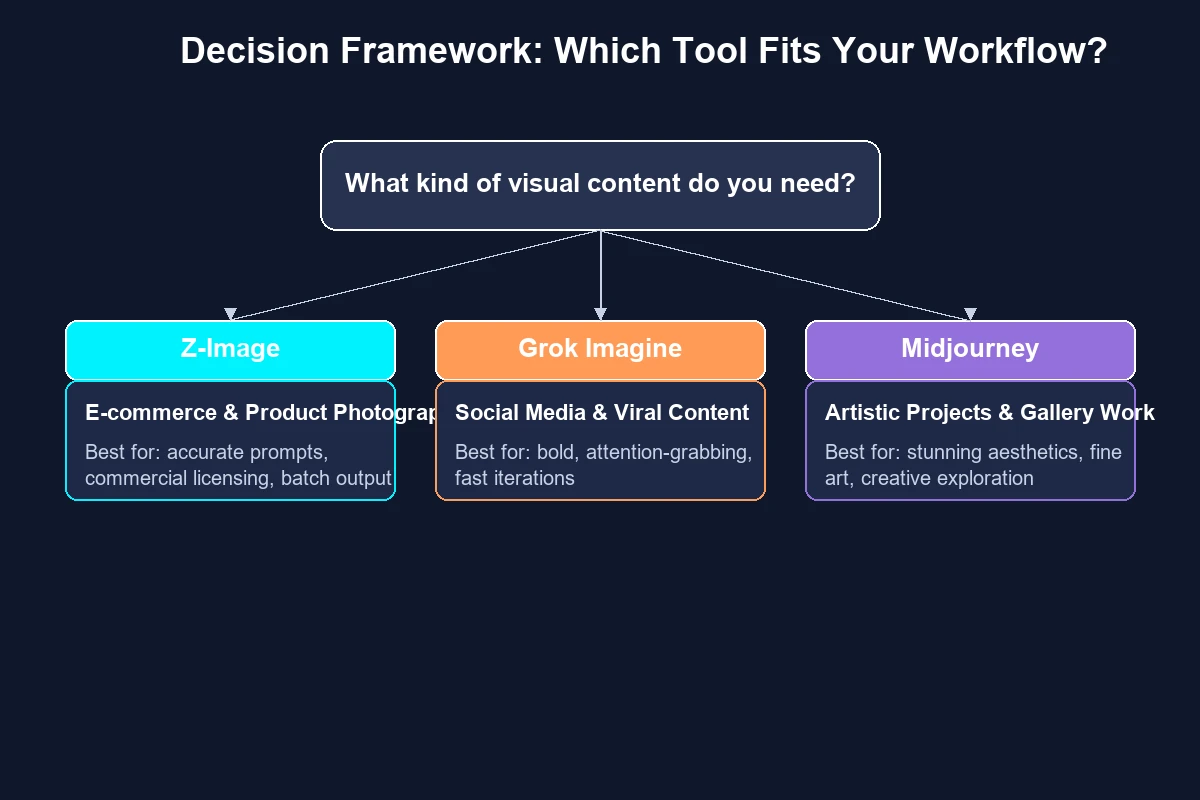
Scenario 1: E-Commerce & Product Photography
Recommended: Z-Image
Product listings require consistency, accuracy, and clear licensing. Z-Image delivers:
- Precise product visualization
- Batch processing for large catalogs
- Commercial-safe aesthetics
- Cost-effective scaling
Example workflow: Upload product photos �?Generate lifestyle contexts �?Batch export 50 variations �?Publish to Shopify/Amazon
Scenario 2: Social Media & Content Creation
Recommended: Grok Imagine
Viral content demands attention. Grok provides:
- Stop-scrolling visual impact
- Rapid iteration for trending topics
- Platform-optimized aesthetics
- Affordable entry point
Example workflow: Identify trending topic �?Generate 10 thumbnail options �?A/B test �?Publish best performer
Scenario 3: Professional Art & Design
Recommended: Midjourney
Portfolio and client work require the highest quality. Midjourney offers:
- Gallery-ready output
- Extensive stylistic range
- Industry-standard quality
- Active learning community
Example workflow: Concept sketch �?Midjourney refinement �?Client review �?Final polish in Photoshop
Scenario 4: Hybrid Professional Workflow
Recommended: Z-Image + Midjourney Combo
Many professionals benefit from both tools:
- Z-Image: Client deliverables, commercial projects, quick turnaround
- Midjourney: Creative exploration, portfolio pieces, artistic projects
This dual-tool approach covers 95% of professional image generation needs.
2026 Trends & Future Outlook
Based on our testing and industry analysis, here are key developments shaping AI image generation in 2026:
1. Vertical Specialization
General-purpose tools face pressure from specialized competitors:
- E-commerce-focused: Tools trained specifically on product photography
- Game development: Optimized for texture generation and concept art
- Video generation: Image-to-video capabilities expanding rapidly
Prediction: By 2027, “general” AI image generators will be primarily used by generalists, while professionals adopt vertical tools.
2. Real-Time Generation
Current generation speeds (2-5 seconds) will drop to milliseconds. Implications:
- Live preview while typing prompts
- Interactive creative sessions
- Integration with design software for instant feedback
3. Video Generation Maturation
Following Sora’s 2024 launch, video generation is becoming practical:
- 5-10 second clips are now production-quality
- Image generators increasingly add video modes
- Full video workflow integration by 2027
4. Copyright Clarity
Legal frameworks are stabilizing:
- Clearer training data licensing
- Standardized commercial use terms
- Attribution and provenance tracking
5. Custom Model Training
Brand-specific models are becoming accessible:
- Train on 50-100 brand images
- Generate new content in brand style automatically
- Premium service tier for enterprises
Frequently Asked Questions
Q: Can I use these images commercially?
Z-Image: Yes, full commercial rights included with all paid plans. Free tier allows commercial use with attribution.
Midjourney: Paid plans include commercial rights. Free tier is personal use only.
Grok Imagine: Subject to xAI’s terms of service. Check current terms before commercial use, as policies evolve.
Q: What’s the best free AI image generator?
For 2026, Z-Image offers the most generous free tier (100 images/month) with commercial rights. Midjourney’s free tier is extremely limited (~25 generations). Grok requires X Premium subscription ($8/month).
Q: Do I need to learn prompt engineering?
Z-Image: No, natural language descriptions work well.
Midjourney: Recommended. Investment in prompt engineering significantly improves results.
Grok: Optional. The tool is designed for quick, intuitive use.
Q: Will AI replace graphic designers?
Not in the near term. AI changes the role rather than eliminating it:
- Before AI: Designers spent 70% on execution, 30% on strategy
- With AI: Designers spend 30% on execution, 70% on strategy
Designers who master AI collaboration gain significant productivity advantages. Those who don’t adapt may face competitive pressure.
Q: Which tool has the best community?
Midjourney has the largest and most active community (20M+ Discord members). Z-Image has growing Chinese-language communities. Grok integrates with X’s broader ecosystem.
Final Verdict
Choosing an AI image generator is like choosing a camera: the best tool depends on your specific needs, not absolute quality rankings.
- Need reliability and business features? �?Z-Image
- Need artistic excellence? �?Midjourney
- Need viral impact? �?Grok Imagine
All three offer free trials or entry points. We recommend testing your actual use cases directly—run identical prompts through each tool and evaluate which output best matches your vision.
Our team uses all three: Z-Image for client work requiring consistency, Midjourney for creative exploration, and Grok for experimental projects.
Related Resources
- Complete Guide to AI Creative Generation
- Z-Image Official Documentation
- Midjourney Community Guide
- 2026 AI Design Trends Report
Try These Prompts Across Different Tools
Test the capabilities of various AI tools with these curated prompts from our library:
For Testing Creative Versatility
- Photo-Grid Tribute Poster - Tests composition and layout skills
- Mixed-Media Collage Posters - Tests artistic style blending
- Urban Photo-Collage Caricature - Tests complex scene composition
For Testing Commercial Applications
- 30 Seconds Brand Kit - Tests brand consistency
- Modern Sport Poster - Tests typography and layout
- 5-Step Marketing Flowchart - Tests diagram generation
For Testing Technical Precision
- Prompt Structure and Visual Elements - Tests prompt adherence
- Accurate Academic Diagram - Tests text rendering and precision
- Architectural Blueprint Generation - Tests technical accuracy
Article Metadata
- Last Updated: February 6, 2026
- Testing Period: January 2026
- Tools Tested: Z-Image (latest), Midjourney V7, Grok Imagine (latest)
- Word Count: ~2,400
- Author: NeoSpark Content Team
Share This Article
Found this helpful? Share it with your network:
Share on X Share on LinkedIn Share on Facebook
This article contains affiliate links. We tested all tools independently and opinions are our own.