Amazon Listing Optimization: The Complete 2026 Guide to Higher Rankings & Sales

Alex Zhang is the founder of NeoSpark, an AI-powered design platform helping creators and teams generate images, videos, and brand assets without design skills.
Amazon Listing Optimization: The Complete 2026 Guide to Higher Rankings & Sales
Published: June 1, 2026 | Reading Time: 15 min | Level: Amazon Seller / FBA Brand
TL;DR: Amazon listings with optimized titles, keywords, and content see 40-60% higher organic traffic. This guide covers the complete optimization framework — from keyword research and title structure to backend search terms and A+ Content — plus AI-powered workflows that cut optimization time from days to hours.
Table of Contents
- Why Amazon Listing Optimization Matters in 2026
- Keyword Research: The Foundation of Optimization
- Crafting the Perfect Amazon Title
- Bullet Points That Convert
- Product Description & Backend Search Terms
- Image Optimization for Clicks & Conversions
- A+ Content That Drives BSR
- Pricing & Offer Strategy
- Review & Rating Management
- AI-Powered Listing Optimization Workflow
- FAQ
- Conclusion
Why Amazon Listing Optimization Matters in 2026
The Amazon Marketplace Reality
Amazon’s marketplace has never been more competitive. With over 2.5 million active sellers and 350 million products, standing out requires more than just a good product — it requires a strategically optimized listing.
| Metric | Optimized Listings | Unoptimized Listings | Difference |
|---|---|---|---|
| Organic search ranking | Top 1-3 positions | Page 2+ | 10x visibility |
| Click-through rate | 0.5-0.8% | 0.2-0.3% | +150% |
| Conversion rate | 12-18% | 6-8% | +100% |
| Daily sales velocity | 20-50 units/day | 2-5 units/day | 10x |
| BSR improvement | Top 1,000 | 50,000+ | 50x |
Source: Amazon Seller Central data and NeoSpark platform analytics, 2025-2026
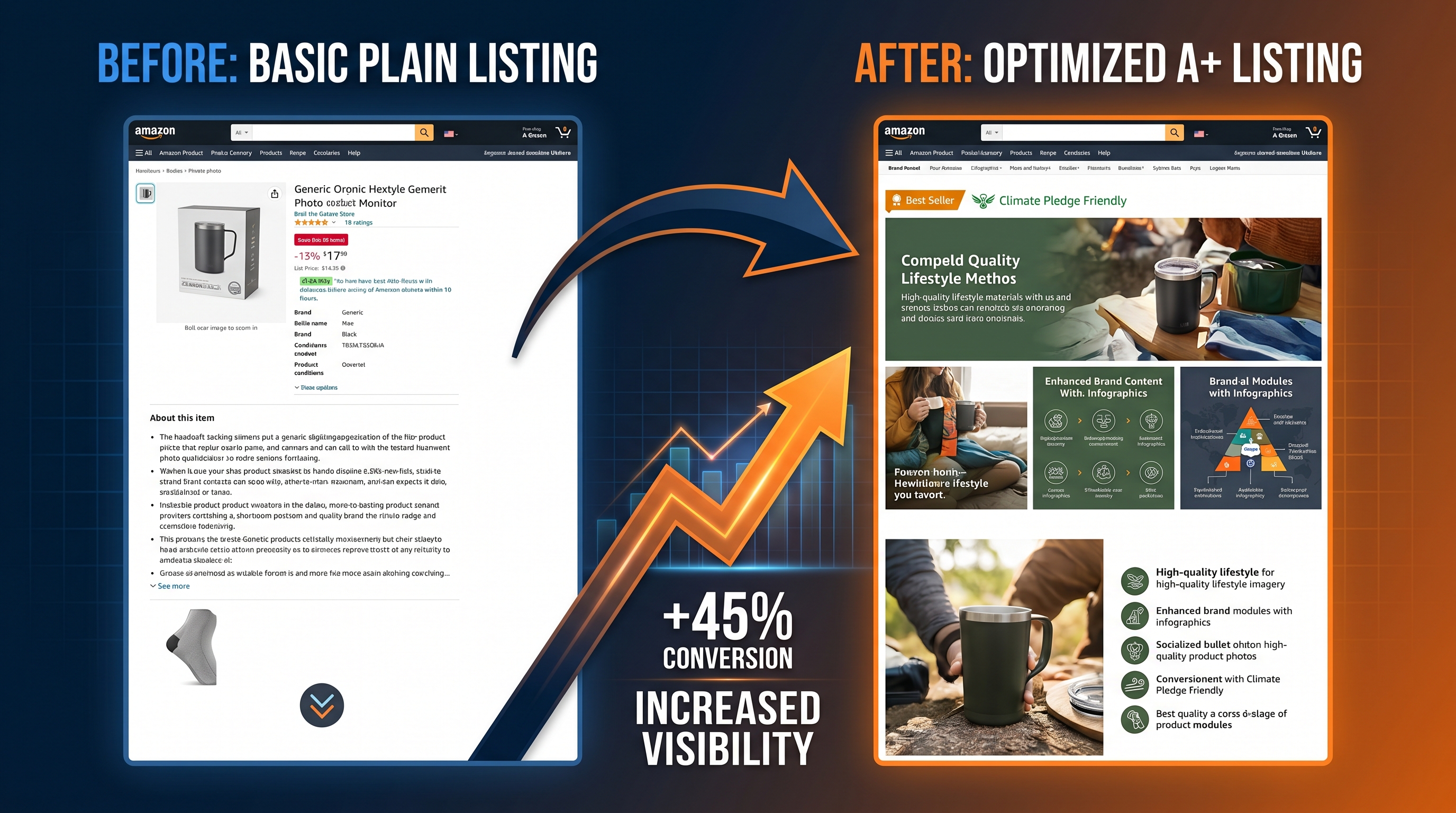 Optimized listings achieve 10x higher visibility and 2x conversion rates
The A10 Algorithm Update
Amazon’s A10 algorithm (evolved from A9) now weighs these factors more heavily:
Primary Ranking Factors:
- Relevance: Keyword match in title, bullets, and backend
- Sales velocity: Consistent daily sales volume
- Conversion rate: Clicks that turn into purchases
- Customer satisfaction: Low return rates, positive reviews
- Price competitiveness: Relative to similar products
Secondary Factors:
- Inventory depth: Consistent stock availability
- Fulfillment method: FBA vs FBM preference
- Brand registry: Enhanced content access
- External traffic: Off-Amazon traffic signals
- Session duration: Time customers spend on listing
Keyword Research: The Foundation of Optimization
Finding High-Value Keywords
Effective Amazon keyword research identifies terms with:
- High search volume (monthly searches)
- Strong commercial intent (high CPC indicates buying intent)
- Manageable competition (not dominated by major brands)
- Product relevance (actual match to your offering)
| Keyword | Monthly Volume | CPC | Competition | Opportunity |
|---|---|---|---|---|
| amazon listing optimization | 1,000 | $6.52 | Medium | High intent |
| amazon listing | 2,400 | $4.28 | High | Brand defense |
| amazon product listing | 1,300 | $4.15 | Medium | Core term |
| optimize amazon listing | 210 | $4.89 | Low | Long-tail win |
| amazon listing optimization service | 140 | $8.12 | Medium | Service intent |
| amazon listing optimization software | 90 | $5.23 | Low | Tool intent |
| amazon listing optimization tools | 70 | $4.56 | Low | Tool intent |
| amazon listing optimization tips | 20 | $1.89 | Low | Informational |
| amazon listing optimization checklist | 20 | $2.45 | Low | High intent |
| amazon listing optimization best practices | 10 | $3.56 | Low | Authority play |
Data: Semrush US database, June 2026
Keyword Research Tools
| Tool | Best For | Cost | Integration |
|---|---|---|---|
| Helium 10 | Amazon-specific data | $99/month | Native |
| Jungle Scout | Product research + keywords | $49/month | Chrome extension |
| Semrush | Cross-platform SEO | $119/month | Web + API |
| MerchantWords | Amazon search volume | $35/month | Web only |
| NeoSpark AI | Automated keyword extraction | Included | Platform integration |
Keyword Classification Framework
Primary Keywords (1-2 terms):
- Highest search volume for your product
- Must appear in title
- Example: “wireless earbuds”, “yoga mat”, “coffee maker”
Secondary Keywords (3-5 terms):
- Moderate volume, high relevance
- Distributed across bullets and description
- Example: “bluetooth headphones for gym”, “non-slip exercise mat”, “programmable drip coffee maker”
Long-Tail Keywords (10+ terms):
- Lower volume, higher conversion intent
- Backend search terms and hidden keywords
- Example: “wireless earbuds with noise cancellation for running”, “extra thick yoga mat with carrying strap”
Crafting the Perfect Amazon Title
Amazon Title Requirements (2026)
| Element | Specification | Impact |
|---|---|---|
| Character limit | 200 characters (most categories) | Visibility |
| Capitalization | Title case (first letter of each word) | Professionalism |
| Numbers | Use numerals (“5” not “Five”) | Space efficiency |
| Units | Abbreviate where possible (“oz”, “lb”, “in”) | Space efficiency |
| Prohibited | Promotional language, symbols, all caps | Compliance |
The 5-Element Title Formula
[Brand] + [Primary Keyword] + [Key Feature] + [Material/Model] + [Size/Color] + [Use Case]
Example — Optimized Title:
SoundPro Wireless Bluetooth Earbuds with Noise Cancellation, IPX7 Waterproof Sport Headphones, 48-Hour Battery, Built-in Mic, Black
Title Breakdown:
| Element | Content | Purpose |
|---|---|---|
| Brand | SoundPro | Brand recognition |
| Primary keyword | Wireless Bluetooth Earbuds | Core search term |
| Key feature 1 | Noise Cancellation | Differentiator |
| Key feature 2 | IPX7 Waterproof | Use case signal |
| Use case | Sport Headphones | Audience targeting |
| Specification | 48-Hour Battery | Value proposition |
| Feature | Built-in Mic | Secondary benefit |
| Variant | Black | Color specification |
Mobile Title Optimization
Amazon mobile displays approximately 80 characters of the title. The first 80 characters must contain:
- Brand name
- Primary keyword
- Most compelling feature
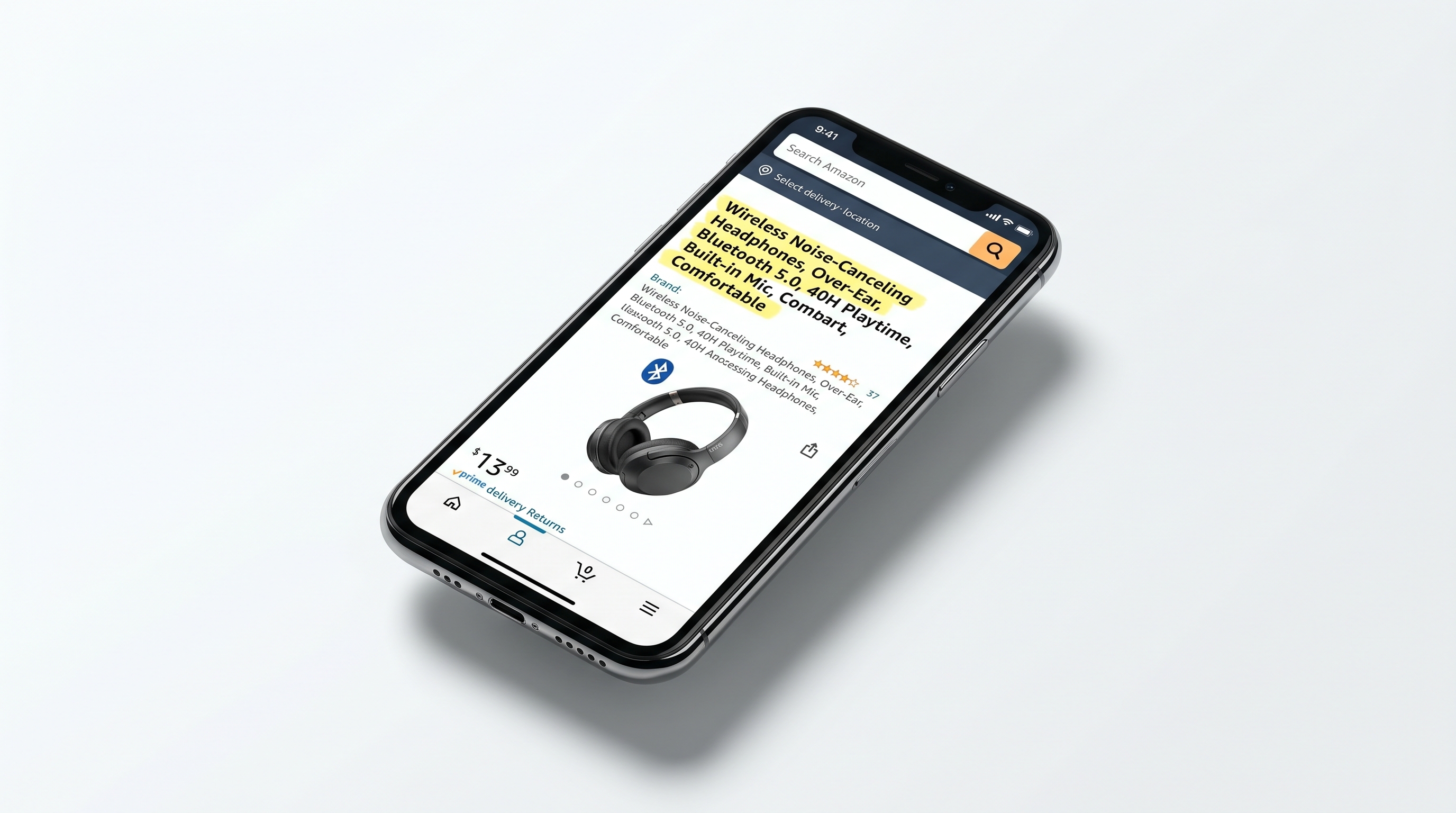 Mobile shoppers see only the first 80 characters — make them count
Bullet Points That Convert
The 5-Bullet Framework
Amazon allows 5 bullet points (up to 500 characters each). Each bullet should serve a specific purpose:
| Bullet | Purpose | Content Focus |
|---|---|---|
| Bullet 1 | Primary benefit | Solve the main customer problem |
| Bullet 2 | Key feature | Technical specification + benefit |
| Bullet 3 | Differentiation | What makes you better than competitors |
| Bullet 4 | Use case | How and where customers use it |
| Bullet 5 | Trust & guarantee | Warranty, support, brand promise |
Bullet Point Best Practices
Format:
- Start with a feature in ALL CAPS (3-5 words)
- Follow with a benefit-focused explanation (2-3 sentences)
- Include relevant keywords naturally
- Keep under 500 characters per bullet
Example — Optimized Bullet Points:
🎵 PREMIUM SOUND QUALITY — Experience crystal-clear audio with 12mm dynamic drivers and advanced AAC codec support. Every beat, podcast, and call delivers rich, immersive sound that rivals premium headphones at 3x the price.

🔋 ALL-DAY 48-HOUR BATTERY — A single charge powers 8 hours of continuous playback, while the compact charging case extends total listening time to 48 hours. Perfect for long commutes, travel days, and gym sessions without battery anxiety.

💧 IPX7 WATERPROOF RATING — Built for intense workouts and outdoor adventures, these earbuds withstand rain, sweat, and even accidental submersion. The nano-coating technology protects internal components from moisture damage.

📱 UNIVERSAL COMPATIBILITY — Seamlessly pairs with iPhone, Android, tablets, and laptops via Bluetooth 5.3. The multi-point connection lets you switch between two devices instantly — answer calls on your phone while watching videos on your laptop.

✅ 2-YEAR WARRANTY + 24/7 SUPPORT — Every purchase includes a hassle-free 2-year replacement warranty and lifetime technical support. Our US-based customer team responds within 2 hours, guaranteed.
Keyword Distribution in Bullets
| Bullet | Primary Keywords | Secondary Keywords | Long-Tail Keywords |
|---|---|---|---|
| 1 | wireless earbuds, sound quality | bluetooth headphones, premium audio | crystal-clear audio for commuting |
| 2 | battery life, wireless charging | all-day battery, charging case | 48-hour battery for travel |
| 3 | waterproof earbuds, sport | IPX7 rating, workout headphones | sweatproof headphones for gym |
| 4 | bluetooth 5.3, compatible | universal compatibility, multi-point | earbuds for iPhone and Android |
| 5 | warranty, customer support | hassle-free replacement, technical support | lifetime support for earbuds |
Product Description & Backend Search Terms
Product Description Structure
For sellers without Brand Registry (plain text description):
Section 1: The Hook (First 2 lines)
- Grab attention with a compelling question or statement
- Include primary keyword naturally
Section 2: The Story (3-4 paragraphs)
- Why this product exists
- What problem it solves
- Who it’s for
- How it improves the customer’s life
Section 3: Specifications Table
- Technical details in scannable format
- Dimensions, materials, compatibility
- Package contents
Section 4: The Call to Action
- Why buy now
- Risk reversal (guarantee)
- Social proof mention
Backend Search Terms (Hidden Keywords)
Amazon allows 250 bytes per backend search term field (5 fields total = 1,250 bytes).
Rules:
- No repeating keywords already in title/bullets
- Include synonyms, abbreviations, and alternate names
- Add Spanish and other language terms
- Include misspellings customers might search
- Separate with spaces only (no commas)
Example Backend Search Terms:
earphones ear buds ear buds wireless bluetooth earphones in ear headphones running earbuds workout earbuds gym earbuds sport earbuds waterproof earbuds sweatproof earbuds noise cancelling earbuds anc earbuds wireless headphones bluetooth earbuds iphone earbuds android earbuds earbuds with microphone hands free earbuds true wireless earbuds tws earbuds
Image Optimization for Clicks & Conversions
The 7-Image Strategy
| Image | Purpose | Mobile Impact | Optimization Priority |
|---|---|---|---|
| 1 — Main | Drive clicks from search | Critical (thumbnail) | #1 |
| 2 — Infographic | Communicate features | High | #2 |
| 3 — Lifestyle | Show product in use | High | #3 |
| 4 — Details | Build trust through close-ups | Medium | #4 |
| 5 — Scale | Prevent returns | Medium | #5 |
| 6 — Bundle | Set expectations | Medium | #6 |
| 7 — Social Proof | Reviews, awards, certifications | Medium | #7 |
Image Technical Requirements
| Requirement | Specification | Common Mistake |
|---|---|---|
| Minimum size | 1000×1000px (2000×2000px recommended) | Uploading 500px images |
| Background | Pure white RGB(255,255,255) | Off-white or cream |
| Product fill | 85%+ of frame | Too much white space |
| File format | JPEG, PNG, TIFF | Using WebP |
| File size | Under 10MB | Uncompressed 20MB+ files |
| Color mode | sRGB or CMYK | ProPhoto RGB |
AI-Powered Image Creation
NeoSpark’s E-Commerce Listing Expert generates:
- Amazon-compliant main images with pure white backgrounds
- Feature infographics with icons and benefit callouts
- Lifestyle scenes showing product in real-world contexts
- A+ Content modules with brand storytelling
💡 Tip: Using NeoSpark's Amazon template, generate a complete 7-image set in under 10 minutes from a single product description — no photo uploads or prompt writing required.
A+ Content That Drives BSR
What is A+ Content?
A+ Content (formerly Enhanced Brand Content) is available to Brand Registry sellers and allows:
- Rich text formatting and enhanced images
- Comparison charts and product line showcases
- Brand storytelling modules
- Premium layouts with multiple image-text combinations
Performance Impact:
- Average conversion rate increase: 5-10%
- Return rate reduction: 10%
- Customer trust improvement: Significant
- BSR improvement: 15-25% faster
A+ Content Modules That Convert
| Module | Best Used For | AI Application |
|---|---|---|
| Standard Image | Brand story, lifestyle | Scene generation |
| Standard Text | Detailed descriptions | Copywriting assistance |
| Single Image & Text | Key features | Image + copy combination |
| Image & Text Overlay | Callouts, guarantees | Graphics generation |
| Comparison Table | Product line showcase | Layout automation |
| Carousel | Multiple angles/views | Batch image generation |
A+ Content Module Planning (5-7 Modules)
- Brand Hero Image — Brand story + emotional connection
- Feature Highlights (2-3 modules) — Key differentiators
- Lifestyle Images (1-2 modules) — Real-world usage
- Comparison Table — Product line or vs. competitors
- Brand Values/Story — Trust and mission
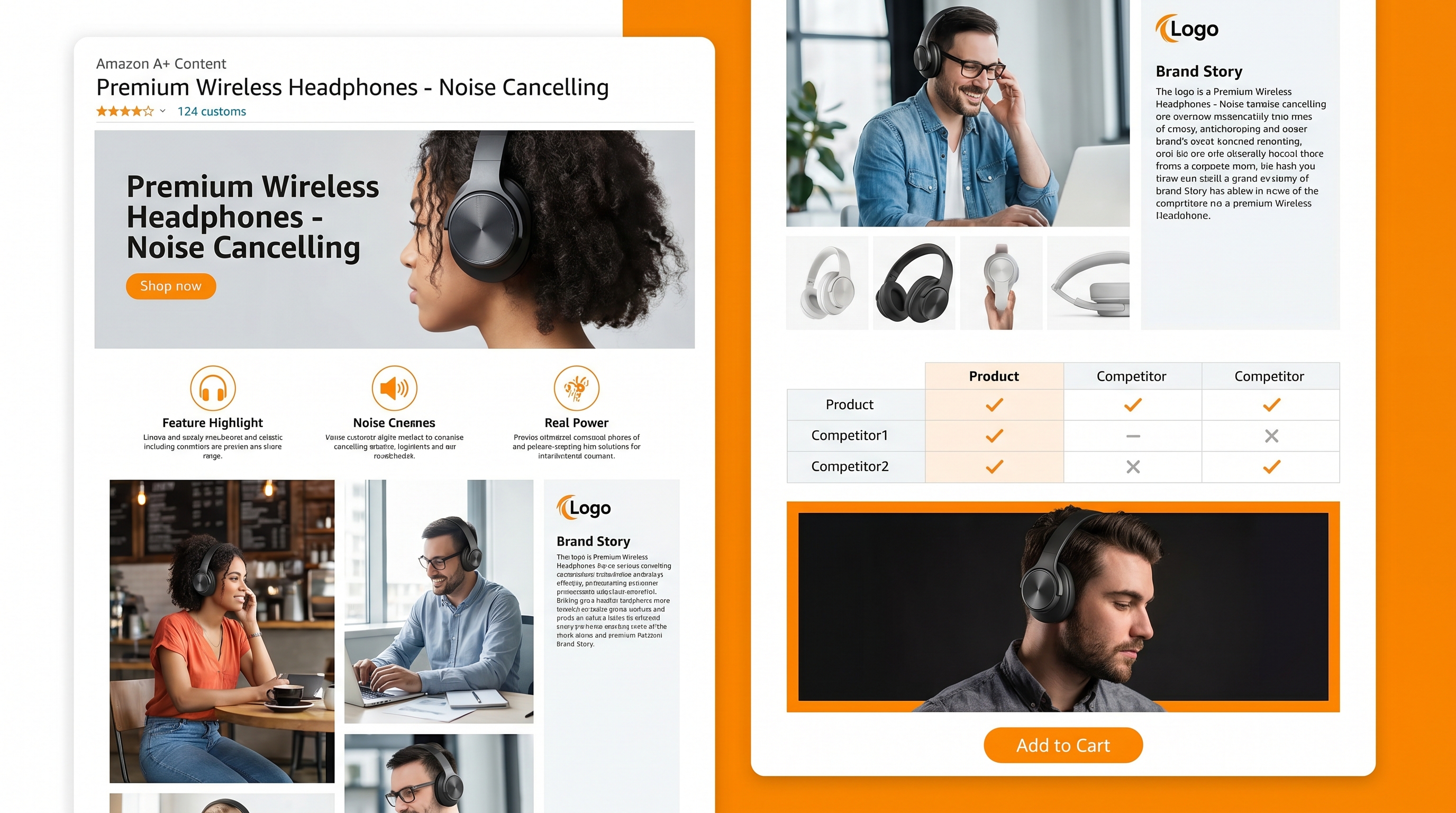 A+ Content module structure optimized for conversion and BSR
Pricing & Offer Strategy
The Psychology of Amazon Pricing
| Price Point | Perception | Strategy |
|---|---|---|
| $19.99 | Entry-level, low risk | Volume play |
| $29.99-$39.99 | Mainstream, good value | Sweet spot for most categories |
| $49.99-$69.99 | Premium, quality signal | Feature-rich positioning |
| $79.99+ | Luxury/expert-grade | Niche targeting |
Pricing Optimization Tactics
- Charm Pricing: End in .97 or .99 (Amazon’s algorithm favors competitive prices)
- Bundle Offers: Increase average order value with multi-packs
- Coupons: Visible “clip coupon” badges increase CTR by 15-20%
- Subscribe & Save: Recurring revenue + higher search ranking
- Lightning Deals: Temporary price drops for rank boost
Review & Rating Management
The Review Velocity Impact
| Rating | Click-Through Rate | Conversion Rate | BSR Impact |
|---|---|---|---|
| 4.8-5.0 stars | +35% | +40% | Strong positive |
| 4.3-4.7 stars | +15% | +20% | Moderate positive |
| 3.8-4.2 stars | Baseline | Baseline | Neutral |
| 3.0-3.7 stars | -25% | -35% | Negative |
| Below 3.0 | -50% | -60% | Suppression risk |
Review Generation Strategies
- Amazon Vine Program: 1-30 reviews from trusted reviewers (free units required)
- Post-Purchase Email Sequences: Request reviews after delivery confirmation
- Product Inserts: Thank-you cards with review request (within Amazon’s guidelines)
- Follow-Up Services: Use Amazon’s “Request a Review” button (90 days)
Warning: Never offer compensation for reviews, request only positive reviews, or use review manipulation services. Amazon suspends accounts for these violations.
AI-Powered Listing Optimization Workflow
The Traditional vs. AI Optimization Comparison
| Task | Traditional Method | AI Method (NeoSpark) | Time Saved |
|---|---|---|---|
| Keyword research | 4-6 hours (manual analysis) | 15 minutes (AI extraction) | 95% |
| Title writing | 1-2 hours (draft + review) | 2 minutes (AI generation) | 98% |
| Bullet points | 2-3 hours (5 bullets) | 3 minutes (AI generation) | 97% |
| Image creation | 1-2 days (photography + editing) | 10 minutes (AI generation) | 99% |
| A+ Content | 1-2 weeks (design + copy) | 30 minutes (AI generation) | 98% |
| Backend terms | 1-2 hours (manual compilation) | 5 minutes (AI extraction) | 96% |
| Total per listing | 3-5 days | 1 hour | 95% |
Step-by-Step AI Optimization Workflow
Step 1: Keyword Extraction with AI
- Enter your product description or competitor ASIN into NeoSpark
- AI extracts top 50-100 relevant keywords with search volume estimates
- Export categorized keyword list (primary, secondary, long-tail)
Step 2: Generate Optimized Copy
- Input product brief and target keywords
- AI generates title, bullets, and description simultaneously
- Review and edit for brand voice and accuracy
- All keywords naturally integrated without keyword stuffing
Step 3: Create Conversion-Optimized Images
- Select “Amazon Listing” template in NeoSpark
- AI generates 7-image set:
- Main image (white background, Amazon-compliant)
- Feature infographic (icons + benefits)
- Lifestyle scenes (2-3 contexts)
- Detail/texture close-ups
- Scale reference image
- Bundle/what’s included shot
- Export in Amazon-required specifications
Step 4: Build A+ Content
- Choose A+ Content module layout
- AI generates brand story, feature modules, and comparison tables
- All images auto-formatted for Amazon A+ specifications
- Copy optimized for both conversion and keyword relevance
Step 5: Backend Search Terms
- AI scans all generated content
- Extracts unused keywords, synonyms, and alternate spellings
- Compiles backend search terms within 1,250-byte limit
- Ensures no duplication with visible content
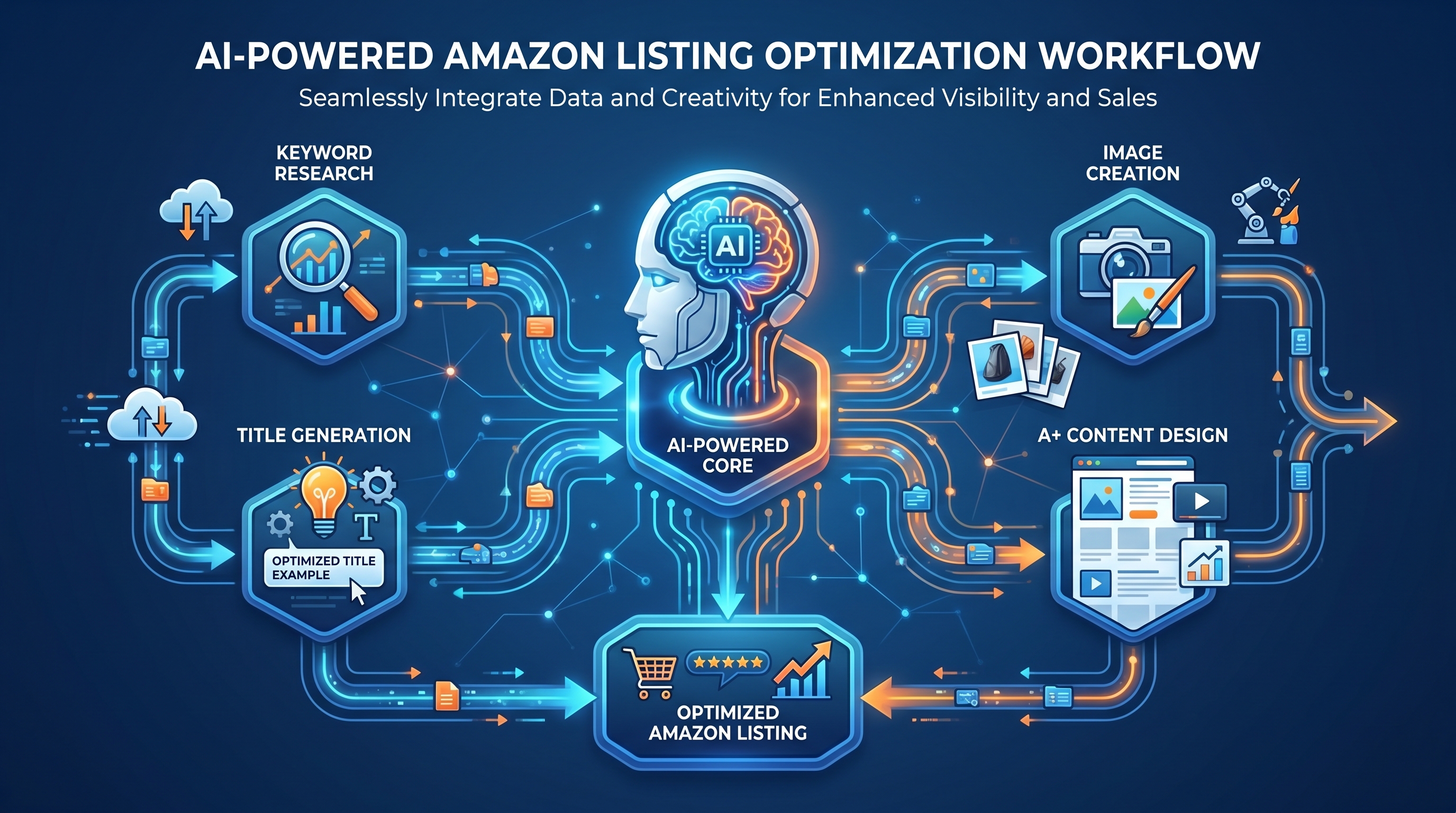 NeoSpark’s AI-powered listing workflow reduces optimization time from days to under 1 hour
Batch Optimization for Catalogs
For sellers with 50+ SKUs:
| Phase | Action | Time Required |
|---|---|---|
| Template Setup | Define brand voice, style, and keywords | 1 hour (one-time) |
| Batch Upload | Import product catalog (CSV/Excel) | 15 minutes |
| Auto-Generation | AI processes all listings simultaneously | 2-4 hours |
| Review & Approve | Quality check each listing | 2-3 hours |
| Amazon Export | Download Amazon-ready files | 15 minutes |
Total time for 50 SKUs: ~6 hours vs. 3-5 weeks traditional
FAQ
What is Amazon listing optimization?
Amazon listing optimization is the systematic improvement of product listings to increase organic search visibility, click-through rates, and conversion rates. It involves optimizing titles, keywords, bullet points, images, descriptions, pricing, and backend search terms to align with Amazon’s A10 algorithm and shopper behavior.
How much does Amazon listing optimization cost?
| Service Type | Cost Range | Best For |
|---|---|---|
| DIY optimization | $0 (time only) | Experienced sellers with time |
| AI tools (NeoSpark) | $19-49/month | Most sellers |
| Freelance optimizer | $50-200 per listing | One-time optimization |
| Agency service | $500-2,000 per listing | Premium brands |
| Optimization software | $99-299/month | High-volume sellers |
Can I do Amazon listing optimization myself?
Yes, with the right tools and knowledge. The key components are:
- Keyword research (using Helium 10, Jungle Scout, or NeoSpark)
- Understanding Amazon’s title and content requirements
- Creating compliant, high-converting images
- Writing benefit-focused copy with natural keyword integration
- Monitoring and iterating based on performance data
AI tools like NeoSpark significantly reduce the learning curve and time investment.
What are the best Amazon listing optimization tools?
| Tool Category | Top Tools | Primary Use |
|---|---|---|
| Keyword research | Helium 10, Jungle Scout, Semrush | Find high-value keywords |
| Listing creation | NeoSpark, CopyMonkey, Jasper | Generate optimized copy |
| Image creation | NeoSpark, Canva, Adobe Firefly | Create compliant images |
| Analytics | Seller Central, DataDive, ManageByStats | Track performance |
| A/B testing | Splitly, Amazon’s own experiments | Optimize listings |
How long does it take to see results from listing optimization?
| Timeline | Expected Results |
|---|---|
| 24-48 hours | Indexing of new keywords; search visibility changes |
| 1-2 weeks | Click-through rate improvements; ranking shifts |
| 2-4 weeks | Conversion rate changes; sales velocity impact |
| 4-8 weeks | BSR stabilization; sustained organic ranking |
| 8-12 weeks | Full optimization impact; compounding results |
Should I hire an Amazon listing optimization expert or agency?
Consider hiring an expert if:
- You’re launching a new brand with high-stakes SKUs
- You have 50+ SKUs and need systematic optimization
- Your current listings are underperforming and you can’t identify why
- You lack time or expertise for DIY optimization
Consider DIY or AI tools if:
- You have 1-20 SKUs
- You want to learn and maintain control
- Budget is limited
- You prefer rapid iteration
What is Amazon listing optimization software?
Amazon listing optimization software automates keyword research, copy generation, image creation, and performance tracking. Modern AI-powered tools like NeoSpark can:
- Extract keywords from competitor listings
- Generate complete optimized copy (titles, bullets, descriptions)
- Create Amazon-compliant images and A+ Content
- Compile backend search terms
- Monitor ranking and conversion changes
What should an Amazon listing optimization checklist include?
Pre-Launch Checklist:
- Primary keyword research completed (20+ terms)
- Title optimized (200 chars, keyword-rich, mobile-friendly)
- 5 bullet points written (benefit-focused, keyword-integrated)
- Product description complete (story + specs + CTA)
- Backend search terms filled (1,250 bytes, no duplicates)
- 7 images created (compliant, conversion-optimized)
- A+ Content modules planned (if Brand Registry)
- Pricing competitive with market
- Inventory depth sufficient for launch velocity
- Review generation strategy ready
Post-Launch Checklist:
- Monitor search ranking daily (first 2 weeks)
- Track CTR and conversion rate changes
- A/B test title and main image variations
- Adjust pricing based on competitor changes
- Respond to customer questions within 24 hours
- Request reviews from verified purchasers
- Update inventory to avoid stockouts
- Analyze search term reports for new keywords
How do I optimize my Amazon listing for mobile?
Mobile Optimization Priorities:
- Title: First 80 characters must contain brand + primary keyword + top feature
- Images: Ensure product is recognizable at 150px thumbnail size
- Infographics: Minimum 24pt equivalent font size for mobile readability
- Bullets: Lead with the most important benefit (first 100 characters visible)
- Price: Display prominently; coupon badges increase mobile CTR by 20%
What are Amazon listing optimization best practices for 2026?
Top 10 Best Practices:
- Research keywords before writing any listing content
- Write titles for mobile (first 80 characters are critical)
- Lead bullets with benefits, not features
- Include at least one lifestyle image among 7 slots
- Use A+ Content if Brand Registry eligible
- Maintain 15-20% price competitiveness vs. market
- Generate reviews within first 30 days of launch
- Update listings seasonally (holidays, events)
- Monitor competitor changes and respond quickly
- Use AI tools for speed; human review for quality
Conclusion
Amazon listing optimization in 2026 is both an art and a science. The sellers winning on Amazon combine:
- Data-driven keyword research — Understanding what customers actually search for
- Conversion-focused copywriting — Benefits before features, always
- Compliance-first imagery — Meeting Amazon’s requirements while driving clicks
- Continuous iteration — Testing, measuring, and improving over time
- AI-powered efficiency — Using tools like NeoSpark to scale optimization without scaling headcount
The frameworks in this guide enable you to:
- Rank higher for your target keywords
- Convert more browsers into buyers
- Reduce return rates through accurate expectations
- Build brand equity through consistent A+ Content
- Scale optimization across 10, 50, or 500 SKUs
“The difference between a good Amazon listing and a great one isn’t the product — it’s the optimization.”
Ready to optimize your Amazon listings?
Try NeoSpark’s E-Commerce Listing Expert →
Join 5,000+ Amazon sellers using AI to create optimized, high-converting product listings in minutes instead of days.
Additional Resources
- Amazon Listing Image Optimization Guide
- AI Product Photography Complete Guide
- AI Creative Tools Comparison 2026
- Amazon Seller Central Guidelines
Last updated: June 1, 2026