Beauty Product Photography Tips: The Complete Guide for Stunning Cosmetic Images
Alex Zhang is the founder of NeoSpark, an AI-powered design platform helping creators and teams generate images, videos, and brand assets without design skills.
Beauty Product Photography Tips: The Complete Guide for Stunning Cosmetic Images
TL;DR: Great beauty product photography combines precise lighting, thoughtful composition, product-specific styling, and intelligent post-processing. Whether you are shooting skincare serums, makeup palettes, or luxury fragrances, the right setup transforms ordinary product shots into compelling visual assets. This guide covers equipment, lighting techniques, composition strategies, product-specific tips, and how AI tools like NeoSpark can streamline your workflow while elevating results.
Table of Contents
- Why Beauty Photography Is Non-Negotiable
- Essential Equipment for Beauty Photography
- Lighting Techniques
- Composition and Styling
- Product-Specific Tips
- AI Enhancement for Beauty Photos with NeoSpark
- Post-Processing Essentials
- Case Studies
- FAQ
- Conclusion
- Related Resources
Why Beauty Photography Is Non-Negotiable
In the beauty industry, visuals are the primary currency of trust. A potential customer cannot touch, smell, or test your product through a screen. They rely entirely on what they see. High-quality beauty product photography bridges that sensory gap, communicating texture, finish, luxury, and efficacy in a single frame.
The numbers tell a decisive story. Consider the following data on visual commerce in the beauty sector:
| Metric | Statistic | Source / Context |
|---|---|---|
| Purchase influence | 93% of consumers say visual appearance is the key deciding factor | General ecommerce research |
| Beauty category return rate | Returns drop by 22% with accurate product imagery | Ecommerce analytics platforms |
| Social media engagement | Beauty posts with professional photography see 40% higher engagement | Social media marketing studies |
| Mobile shopping | Over 70% of beauty purchases begin on mobile devices | Beauty industry reports |
| Conversion lift | Professional product images increase conversion rates by up to 30% | Ecommerce optimization benchmarks |
Beauty is an aspirational category. Customers are not merely buying a moisturizer or a lipstick. They are buying the promise of transformation, confidence, and self-care. Your photography must evoke that promise. Flat, poorly lit, or inaccurate images do not just fail to sell. They actively erode brand credibility.
Moreover, the beauty market is saturated. New direct-to-consumer brands launch daily. Established houses refresh their lines seasonally. In this crowded landscape, distinctive, polished imagery is often the only differentiator a shopper encounters during their first interaction with your brand.
Essential Equipment for Beauty Photography
You do not need a studio the size of a warehouse to produce exceptional beauty imagery. What you need is the right equipment, chosen with precision and maintained with care.
Camera Body
A DSLR or mirrorless camera with manual controls is essential. Full-frame sensors offer superior dynamic range and low-light performance, which matters when capturing the subtle gradations of skin-toned products and reflective packaging. The Sony A7 series, Canon EOS R line, and Nikon Z series are all excellent choices. If budget is a constraint, modern APS-C bodies from these manufacturers still deliver professional results.
Macro Lens
Beauty photography lives in the details. A dedicated macro lens, typically in the 90mm to 105mm range, allows true 1:1 magnification. This is critical for capturing the texture of a powder compact, the bristles of a brush, or the droplets on a serum bottle. The longer focal length also provides a comfortable working distance and beautiful background compression.
Tripod
A sturdy tripod is non-negotiable. Beauty photography often involves small apertures for depth of field, which means slower shutter speeds. A tripod eliminates camera shake and ensures consistent framing across a product line. Look for a model with a geared center column for fine height adjustments.
Lighting Equipment
Continuous LED panels and strobes each have their place. LEDs allow you to see the exact effect of your lighting in real time, which is invaluable for learning. Strobes deliver more power and sharper freeze-frame detail. For most beauty work, a combination of both offers the greatest flexibility.
Reflectors, Diffusers, and Flags
These are the sculpting tools of light. A five-in-one reflector set provides silver, gold, white, black, and translucent surfaces. Diffusers soften harsh light sources. Flags block unwanted spill. Mastering these accessories separates competent photographers from exceptional ones.
Backgrounds and Surfaces
Invest in a range of backgrounds. Seamless paper in neutral tones, textured vinyl backdrops, acrylic sheets for reflections, and marble or tile surfaces for lifestyle contexts. The background should complement the product without competing for attention.
Lighting Techniques
Lighting is the soul of beauty photography. The same product can appear cheap or luxurious depending entirely on how it is lit. Here are the four foundational techniques every beauty photographer should master.
Soft Box Lighting
A soft box is the workhorse of beauty photography. Its large, diffused surface creates gentle, wrapping light that minimizes harsh shadows and reveals texture without exaggerating imperfections. For skincare products, a large soft box placed at a 45-degree angle above and to the side of the product produces flattering, dimensional illumination. The softness of the light communicates the gentleness and quality associated with premium beauty products.
When shooting a lineup of products, use two identical soft boxes in a clamshell arrangement, one above and one below, to achieve even, shadowless lighting that is ideal for e-commerce catalogs.
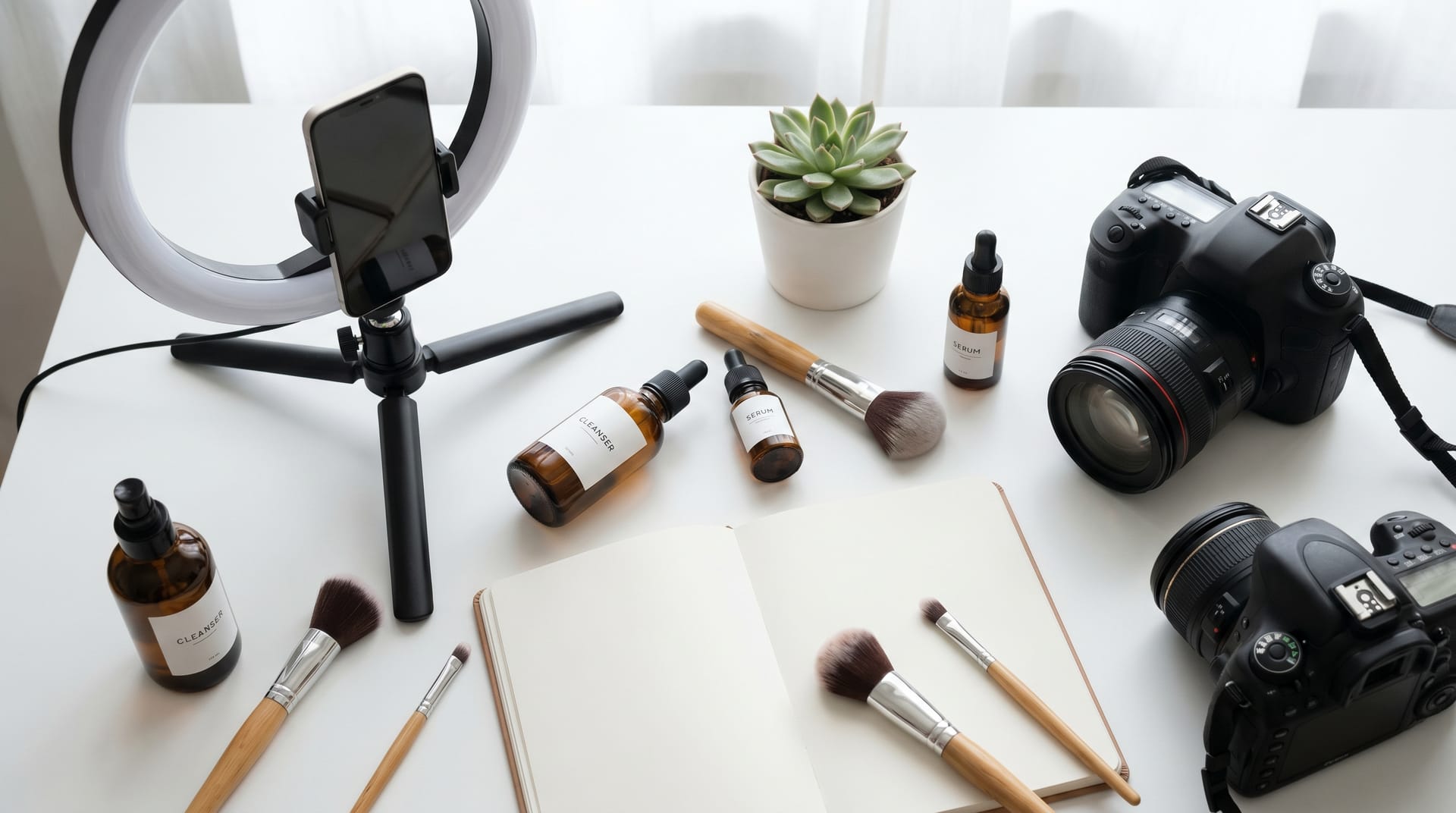
Ring Light for Detail
A ring light produces distinctive, even illumination with a characteristic circular catchlight. In beauty photography, it excels at detail shots where flat, shadow-free lighting is desired. Macro images of lipstick bullets, eyeshadow pans, and brush heads benefit from the ring light’s ability to eliminate the shadows that would otherwise obscure fine detail.
The ring light is also invaluable for swatch photography. When capturing the texture and pigmentation of a product applied to skin, the even illumination ensures accurate color representation across the entire surface.
Natural Light Setup
Natural window light remains one of the most beautiful and cost-effective lighting sources available. North-facing windows provide soft, consistent daylight without direct sun. Position your product near the window and use a white reflector on the opposite side to fill shadows gently.
Natural light excels for lifestyle and editorial beauty photography. It conveys authenticity, freshness, and a connection to the organic ingredients many modern beauty brands emphasize. The key is consistency. Shoot at the same time of day, meter carefully, and use a gray card for white balance to ensure your entire series matches.
Backlighting for Transparency
Many beauty products, particularly serums, oils, and fragrances in glass bottles, contain translucent elements that come alive with backlighting. Position a light source behind the product, either through a translucent background or directed through the product itself, to create a luminous glow.
Backlighting reveals the color, clarity, and viscosity of liquid products in a way front lighting never can. A dropper bottle filled with golden oil becomes radiant. A perfume bottle catches light like a gemstone. The technique requires careful exposure management to avoid blowing out highlights while preserving detail in the product label and cap.
Composition and Styling
Composition transforms a product record into a visual story. The arrangement of elements within the frame guides the viewer’s eye, establishes hierarchy, and communicates brand identity.
Flat Lay Arrangements
Flat lays are a staple of beauty photography, particularly for social media and editorial content. The overhead perspective allows for artful arrangement of multiple products and props. Successful flat lays follow a unifying principle: every element must earn its place.
Start with a hero product and build around it. Use the rule of thirds to place the primary item at an intersection point. Add secondary products at complementary angles. Introduce props, textiles, or botanicals that reinforce the brand story. Leave intentional negative space to prevent visual clutter. The best flat lays feel curated, not crowded.
Hero Shots
The hero shot is the definitive image of a product. It is typically shot at eye level or slightly above, with the product centered and dominant in the frame. Hero shots demand perfection. Every surface must be clean. Every reflection must be intentional. The lighting must reveal form and material without distraction.
For beauty products, hero shots often benefit from a slight three-quarter angle rather than a straight-on view. This reveals depth and dimension, showing the front and a hint of the side. It transforms a flat graphic into an object with presence.
Detail and Macro Shots
Detail shots invite the viewer into an intimate relationship with the product. The twist of a lipstick mechanism. The embossed logo on a powder compact. The pipette releasing a single drop of serum. These images build desire through proximity.
Macro photography in beauty requires precise focus stacking when depth of field becomes impossibly thin. Capture multiple frames at different focus distances and blend them in post-processing to achieve front-to-back sharpness. The result is an image of impossible clarity that feels almost tactile.
Lifestyle Contexts
Lifestyle photography places the product in a scene of use or aspiration. A moisturizer on a marble vanity beside a sprig of eucalyptus. A lipstick held in perfectly manicured fingers. A fragrance bottle on a windowsill at golden hour.
These images sell the dream, not just the product. They allow the customer to imagine the product in their own life. The styling must be aspirational but accessible, luxurious but lived-in. The lighting should feel natural, the composition effortless, even when every element has been placed with surgical intention.
Product-Specific Tips
Different beauty categories present distinct photographic challenges. Understanding these nuances ensures your images accurately represent each product type.
| Category | Key Challenges | Recommended Approach |
|---|---|---|
| Skincare | Translucent bottles, reflective caps, need to convey purity and efficacy | Use backlighting for serums and oils. Keep backgrounds clean and clinical or soft and spa-like depending on brand positioning. Capture texture shots of creams and gels. |
| Makeup | Color accuracy is critical; powders and creams have complex textures | Shoot under standardized 5500K lighting. Use color checker cards for reference. Capture swatches on relevant skin tones. Show product both in packaging and in use. |
| Fragrances | Glass bottles create complex reflections; must convey luxury and emotion | Use gradient lighting to reveal bottle contours. Control reflections with flags and black cards. Consider atmospheric elements like mist, flowers, or fabric to suggest scent notes. |
| Haircare | Products are often large or oddly shaped; need to suggest texture and results | Shoot at angles that minimize distortion. Include hair texture shots or lifestyle images showing results. Use water droplets or lather to suggest freshness and performance. |
For skincare, the emphasis should be on cleanliness, precision, and transformation. For makeup, color fidelity and texture reign supreme. Fragrances demand atmosphere and emotion. Haircare requires a balance of product presentation and implied performance.
AI Enhancement for Beauty Photos with NeoSpark
Even the most meticulously captured beauty photograph can benefit from intelligent enhancement. NeoSpark is an AI-powered design platform built specifically for product photography workflows, offering tools that accelerate post-production while preserving creative control.
Background Removal and Replacement
Beauty products frequently need to be placed on pure white backgrounds for marketplace compliance or integrated into lifestyle scenes for campaigns. NeoSpark’s AI background removal isolates products with hair-edge precision, even around complex elements like brush bristles and translucent droppers. The replacement tool then allows you to position the product on any background while automatically matching perspective, lighting direction, and shadow consistency.
Intelligent Retouching
Dust, fingerprints, and packaging imperfections are inevitable during a shoot. NeoSpark’s retouching tools identify and eliminate these distractions without softening the product’s edges or altering its material character. The AI understands the difference between a surface flaw and intentional texture, preserving the embossed logo while removing the speck of dust beside it.
Color Calibration
Color accuracy is paramount in beauty photography. NeoSpark analyzes your image against reference data and suggests corrections to achieve true-to-life color representation. This is especially valuable for makeup photography, where a lipstick shade must match the customer’s expectation exactly.
Resolution Enhancement
Legacy product images or crops from larger compositions often lack the resolution needed for print or high-DPI displays. NeoSpark’s upscaling technology reconstructs detail using generative models trained on product photography, producing enlargements that remain sharp and artifact-free.
Batch Processing
Beauty brands shoot in series. A single product line might require fifty images with consistent treatment. NeoSpark’s batch processing applies your established corrections across an entire folder, maintaining uniformity while adapting intelligently to variations in product shape and color.
By integrating NeoSpark into your workflow, you reduce the time between capture and publication without sacrificing quality. The platform augments your expertise rather than replacing it, handling repetitive tasks so you can focus on creative decisions.
Post-Processing Essentials
Post-processing is where good beauty photographs become exceptional ones. The following steps form a reliable workflow.
Raw Processing
Begin with your camera’s raw files. Adjust white balance using a gray card reference captured during the shoot. Set exposure to maximize information in the histogram without clipping highlights. Apply lens corrections for distortion and chromatic aberration. Establish a neutral baseline from which all subsequent adjustments proceed.
Color Grading
Beauty photography benefits from subtle, intentional color grading. Skincare imagery often leans slightly cool and desaturated to suggest clinical purity. Makeup photography should remain neutral to preserve color accuracy. Fragrance images may embrace warmth and contrast to evoke luxury and emotion.
Use selective color adjustments to refine specific hues without global shifts. If a gold cap appears slightly green under your lighting, target the yellow channel rather than warming the entire image.
Sharpening and Detail
Apply capture sharpening to compensate for the softening effects of raw demosaicing. Follow with output sharpening tailored to the destination, whether web, print, or social media. Use masking to apply sharpening only to edges, preserving the smooth gradients of skin-toned backgrounds and product surfaces.
Frequency Separation for Complex Surfaces
For products with complex textures, such as brushed metal caps or fabric packaging, frequency separation allows you to address color and texture independently. Smooth color inconsistencies without destroying surface detail, or enhance texture without altering color.
Final Quality Control
Before export, review your image at 100% magnification. Check for dust spots, sensor artifacts, and unintended reflections. Verify that the product label is legible and that colors match your reference. Export in the appropriate format and color space for the destination platform.
Case Studies
Case Study 1: Indie Skincare Brand Elevates E-Commerce Conversion by 34%
Lumina Botanicals, a direct-to-consumer skincare brand, struggled with inconsistent product imagery across their online store. Their initial photographs, shot on a smartphone with desk lamps, failed to convey the premium positioning of their botanical ingredient line. Customer feedback frequently mentioned that the products looked different in person than online.
They invested in a dedicated photography setup: a Sony A7 IV with a 90mm macro lens, two continuous LED soft boxes, and a white acrylic shooting table. They established a standardized lighting protocol and captured every product from three angles with consistent exposure settings.
Post-processing was streamlined through NeoSpark. Background removal placed each product on pure white for their main store, while lifestyle backgrounds were applied for social media variants. Color calibration ensured that the green glass bottles and golden oils appeared identical across all images.
The results were measurable. Their e-commerce conversion rate increased by 34% within the first quarter. Return rates due to product appearance mismatch dropped by 18%. Social media engagement on product posts doubled. The investment in professional photography, amplified by AI-powered post-processing, paid for itself within two months.
Case Study 2: Luxury Fragrance House Reduces Production Costs by 52%
Maison V��rit��, a niche fragrance house, previously outsourced all product photography to a boutique studio in Paris. Each seasonal campaign required extensive travel, studio rental, and post-production fees. A single campaign of twenty images could cost upwards of fifteen thousand euros and take six weeks from brief to delivery.
They transitioned to an in-house workflow using a mirrorless camera system and NeoSpark for post-production. Their creative director, trained in photography fundamentals, handled the shoots in their atelier using natural window light supplemented by a single strobe with a large soft box.
The critical transformation came in post-production. NeoSpark’s background replacement allowed them to place their fragrance bottles in evocative scenes, Parisian rooftops at dusk, Proven?al lavender fields, without leaving their studio. The AI matched lighting and atmosphere so convincingly that the resulting images were indistinguishable from location shoots.
Production costs fell by 52%. Turnaround time from shoot to publishable asset shrank from six weeks to four days. The creative team gained the ability to iterate rapidly, testing multiple visual concepts for each campaign rather than committing to a single expensive direction.
FAQ
What is the best camera for beauty product photography?
Any modern DSLR or mirrorless camera with manual controls and raw capture capability is sufficient. Full-frame bodies like the Sony A7 IV, Canon EOS R6, or Nikon Z6 II offer superior dynamic range and low-light performance. However, excellent results are achievable with APS-C alternatives. The lens matters more than the body. Invest in a dedicated macro lens before upgrading your camera body.
How do I achieve true color accuracy for makeup photography?
Shoot under standardized daylight-balanced lighting at 5500K. Include a color checker or gray card in your first frame and use it to set white balance and create a color profile. Avoid mixing light sources with different color temperatures. In post-processing, use the color checker reference to calibrate your image before any creative adjustments.
Can I shoot professional beauty product photos with a smartphone?
Yes, with limitations. Modern smartphones have capable sensors and computational photography features. For social media and small-scale e-commerce, a smartphone with good lighting and a tripod can produce acceptable results. However, for print, large-format displays, or situations requiring extreme detail and shallow depth of field, a dedicated camera with a macro lens remains essential.
What background is best for beauty product photography?
The ideal background depends on context. Pure white or light gray is standard for e-commerce catalogs. Textured surfaces like marble, linen, or weathered wood work well for lifestyle and editorial imagery. Acrylic sheets create elegant reflections. The background should complement the product’s color and brand positioning without competing for attention.
How do I photograph reflective beauty packaging without distracting glare?
Control reflections through flagging and diffusion. Place black cards or flags around the product to block unwanted environmental reflections. Use large, soft light sources to create gentle, predictable highlights. A polarizing filter on your lens can reduce specular reflections on non-metallic surfaces. For highly reflective materials, consider a light tent or shooting through a diffusion panel.
How can AI tools improve my beauty photography workflow?
AI tools like NeoSpark accelerate repetitive post-processing tasks including background removal, color calibration, retouching, and resolution enhancement. They allow photographers to batch-process large series while maintaining consistency. The time saved can be reinvested in creative decisions, client communication, or simply increasing throughput without adding staff.
What lighting setup should a beginner start with?
Begin with a single large soft box or a window with sheer curtain diffusion. Add a white reflector on the opposite side to fill shadows. This simple two-source setup, one primary light and one fill, produces flattering, dimensional images for most beauty products. Master this foundation before adding additional lights or more complex arrangements.
Conclusion
Beauty product photography is both a technical discipline and a creative art. The images you create are the primary interface between your brand and your customer in a world where touch and trial are impossible. Every decision, from the angle of a soft box to the placement of a prop, communicates value, quality, and aspiration.
Six Key Takeaways
-
Invest in lighting before gear. A modest camera with exceptional lighting outperforms an expensive camera with poor lighting every time. Soft, controlled light is the foundation of beautiful beauty photography.
-
Match technique to category. Skincare demands purity and transparency. Makeup requires color fidelity. Fragrances need atmosphere. Haircare must imply performance. One approach does not fit all.
-
Master macro technique. Beauty lives in the details. A macro lens and precise focus technique reveal the textures and finishes that differentiate premium products from ordinary ones.
-
Standardize for scale. If you are shooting a product line, establish protocols for lighting, exposure, and composition. Consistency across a catalog builds brand coherence and customer trust.
-
Embrace intelligent post-processing. Tools like NeoSpark do not replace photographic skill. They amplify it, handling repetitive tasks with precision so you can focus on creative refinement.
-
Test and measure. The ultimate judge of your photography is performance. Track engagement, conversion, and return rates. Let data guide your continuous improvement.
The beauty industry will only become more visually driven. Social platforms reward striking imagery. E-commerce marketplaces demand professional presentation. Consumers expect transparency and aspiration in equal measure. By mastering the techniques in this guide and leveraging modern AI tools, you position your brand to thrive in this visual-first landscape.
Related Resources
- NeoSpark AI Photo Enhancement Tools �� Elevate your beauty product images with intelligent background removal, color calibration, and resolution enhancement.
- NeoSpark Product Photography Guide �� A comprehensive walkthrough of equipment, lighting, and workflow for all product categories.
- AI Background Removal for E-Commerce �� Transform product photos with precision background removal and replacement.
- Color Calibration and Correction �� Ensure accurate color representation across your entire beauty product catalog.
- Batch Processing for Product Lines �� Maintain visual consistency at scale with intelligent batch editing.
- NeoSpark Blog: Lighting Setup for Small Studios �� Build a professional lighting environment in limited space and budget.