Early AI Images: A Complete History of AI-Generated Art, Photos & Pictures (1960s-2026)
Alex Zhang is the founder of NeoSpark, an AI-powered design platform helping creators and teams generate images, videos, and brand assets without design skills.
TL;DR
The journey of early AI images spans over six decades, from 1960s computer graphics to 2026’s photorealistic generators. Key milestones include Harold Cohen’s AARON (1973), Google’s DeepDream (2015), Ian Goodfellow’s GANs (2014), and OpenAI’s DALL-E (2021). Each breakthrough brought us closer to today’s stunning AI art capabilities, transforming simple algorithms into creative tools that rival human artists.
Quick Answers: First AI Image, Timeline & History
Before diving into the full history, here are direct answers to the most common questions people ask about early AI images:
What was the first AI generated image?
The earliest computer-generated images appeared in 1965 with algorithmic plotter drawings by Frieder Nake and experiments at Bell Labs by Michael Noll. The first truly autonomous AI art system was Harold Cohen’s AARON (1973), which created original drawings using rule-based creativity.
When did AI generated images start?
AI-generated images started in the 1960s as computer art. The modern AI era began in 2014 with GANs, went viral in 2015 with DeepDream, and became practical for text-to-image generation in 2021 with DALL-E.
What is the oldest AI generated image?
The oldest known AI or computer-generated images are from 1965 — geometric plotter drawings created by Frieder Nake. These predate neural-network art by nearly 50 years.
When did AI images become popular?
AI images first entered mainstream culture in 2015 through DeepDream and the Prisma app. They became widely popular in 2022 with DALL-E 2, Midjourney, and Stable Diffusion.
1. Introduction: The Dawn of Machine Creativity
What was the first AI-generated image? The answer might surprise you—it wasn’t created by a neural network at all.
The history of early AI images begins in the 1960s, when pioneering artists and computer scientists first explored the creative potential of algorithms. From simple geometric patterns to today’s photorealistic portraits, the evolution of AI-generated art represents one of the most fascinating technological journeys of our time.
Understanding this history matters because:
- It reveals how quickly AI art has progressed
- It shows the foundational concepts behind modern tools
- It helps us appreciate the complexity of current systems
- It provides context for where AI art might go next
Thesis: From primitive computer graphics to stunning realism in just six decades—this is the remarkable story of how machines learned to create.
2. What Was the First AI Generated Image?
The question of the first AI generated image depends on how we define “AI.” If we consider any computer-created visual as AI art, the answer stretches back to the 1960s. However, most historians point to Harold Cohen’s AARON (1973) as the first truly autonomous AI art system.
Short answer: The first computer-generated images were created in 1965 by Frieder Nake using a plotter. The first autonomous AI art system was AARON (1973) by Harold Cohen.
2.1 The Prehistoric Era: Before Neural Networks (1960-1980)
Long before “AI art” became a buzzword, creative programmers were exploring the aesthetic possibilities of computers. This era is also the foundation of computer-generated imagery (CGI) history — the first attempts to make machines create pictures.
Key Pioneers:
- Frieder Nake (1965): Created some of the first computer-generated drawings using plotters
- Michael Noll (1960s): Experimented with computer-generated patterns at Bell Labs
- Lillian Schwartz (1960s-70s): Pioneered computer art at Bell Labs, creating animations and still images
Technical Limitations:
- Monochrome displays (primarily black and white)
- Low resolution (often 512x512 pixels or less)
- Limited processing power required simple algorithms
- Output devices were primarily plotters and early printers
The Art: These early works focused on:
- Geometric patterns and mathematical curves
- Randomness and procedural generation
- Algorithmic compositions
- Fractal-like recursive structures
2.2 Oldest AI Generated Images (1960s)
The oldest AI generated images — or more precisely, the oldest computer-generated art — emerged from the intersection of mathematics and early computing hardware.
1965: Frieder Nake’s Plotter Drawings Frieder Nake, a German mathematician and computer artist, created algorithmic drawings using a plotter connected to a mainframe. His works, such as “Hommage à Paul Klee 13/9/65 Nr.2,” are among the first examples of art created entirely by code.
Michael Noll at Bell Labs Around the same time, Michael Noll at Bell Labs generated computer-created patterns and even a computer-generated ballet film. His work explored randomness, symmetry, and mathematical beauty.
Why These Matter:
- They proved computers could produce visual art
- They established the field of computer-generated imagery
- They inspired later AI art researchers
- They showed that creativity could emerge from algorithms
2.3 AARON by Harold Cohen (1973)
Harold Cohen, a British artist, created AARON in 1973—arguably the first truly autonomous AI art system.
What Made AARON Revolutionary:
- Rule-based creativity: Used programmed rules to make artistic decisions
- Autonomous generation: Could create original works without human input
- Consistent style: Developed a recognizable artistic voice over decades
- Physical output: Controlled a robotic drawing arm to create physical art
How AARON Worked:
- Knowledge base of drawing rules and artistic principles
- Decision-making algorithms for composition
- Line-drawing generation for figures and scenes
- Robotic arm execution on paper
Legacy: AARON operated for over 40 years, with Cohen continuously refining its capabilities. It created thousands of original drawings and paintings, proving that machines could develop something resembling artistic style.
2.4 The Foundation Concepts
Rule-Based Image Generation: Early computer art relied on explicit programming:
IF (condition) THEN (draw line at angle X)
REPEAT (pattern) UNTIL (boundary reached)
Mathematical Art Formulas:
- Fractals (Mandelbrot set, 1980)
- Strange attractors
- L-systems for plant generation
- Cellular automata patterns
Limitations of Pre-AI Computer Art:
- No learning from examples
- Limited to programmer-defined rules
- Couldn’t adapt or evolve styles
- Required extensive human coding for each capability
3. When Did AI Generated Images Start? A Complete Timeline
AI-generated images as we know them today began with the convergence of deep learning and big data in the early 2010s. While computer art existed since the 1960s, the modern era of AI image generation truly started in 2014 with Ian Goodfellow’s GANs, followed by the viral explosion of Google’s DeepDream in 2015.
This section traces the critical period when neural networks learned to create.
3.1 The Neural Network Revolution (2010-2014)
The 2010s brought a paradigm shift with deep learning—neural networks with multiple layers capable of learning complex patterns from data.
Key Technical Advances:
- GPUs for training: Massive acceleration of neural network training
- Big data: Large datasets of images became available
- Better architectures: Convolutional Neural Networks (CNNs) proved ideal for images
- Open source frameworks: TensorFlow, PyTorch democratized AI development
3.2 2014 AI Generated Images: The Year GANs Changed Everything
Ian Goodfellow’s breakthrough paper in 2014 introduced GANs—a revolutionary approach to generating realistic images.
How GANs Work:
- Generator: Creates synthetic images from random noise
- Discriminator: Tries to distinguish real from synthetic
- Adversarial training: Both networks improve by competing
- Result: Increasingly realistic generated images
First GAN Results (2014):
- Low resolution (32x32 to 64x64 pixels)
- Blurry, dreamlike faces
- Distinctive artifacts and distortions
- Limited to simple datasets (MNIST, CIFAR-10)
Despite limitations, GANs proved:
- Neural networks could generate novel images
- Adversarial training was incredibly effective
- The path to realistic AI images was open
3.3 2015 AI Generated Images: DeepDream and Style Transfer
In 2015, two breakthroughs made AI art mainstream:
Google DeepDream:
- AI art went viral globally
- Created psychedelic, dreamlike imagery
- Showed what neural networks “see”
Neural Style Transfer:
- Separated content from style
- Allowed photos to be rendered in artistic styles
- Led to apps like Prisma in 2016
3.4 2016-2017: From Apps to High-Resolution Faces
Prisma (2016):
- First mainstream style transfer app
- Over 100 million downloads
- Made AI art accessible on smartphones
NVIDIA Progressive GAN (2017):
- Generated 1024x1024 pixel faces
- Much higher quality than previous attempts
- Still had telltale artifacts
3.5 2020 AI Images: VQGAN+CLIP and Open-Source Experimentation
Before DALL-E, the AI art community experimented with VQGAN+CLIP:
VQGAN (Vector Quantized GAN):
- Generated images from compressed representations
- Higher quality than earlier GANs
- Could work at reasonable resolutions
CLIP (Contrastive Language-Image Pre-training):
- OpenAI’s model connecting text and images
- Understood natural language descriptions
- Could guide image generation toward text prompts
The Colab Notebook Phenomenon:
- Researchers shared Jupyter notebooks
- Anyone could run VQGAN+CLIP for free
- Iterative refinement became popular
- Community developed prompting techniques
Limitations:
- Slow generation (minutes per image)
- Required iterative optimization
- Results were unpredictable
- Quality varied significantly
3.6 Diffusion Models Emerge (2020-2021)
Denoising Diffusion Probabilistic Models (DDPM) offered a new approach:
How Diffusion Works:
- Start with random noise
- Gradually denoise over many steps
- Guide denoising with text or other conditions
- Result: Clean, generated image
Advantages:
- More stable training than GANs
- Better mode coverage (more diverse outputs)
- Scalable to high resolutions
- Natural fit for conditional generation
4. AI Art Timeline: Key Milestones (1965-2026)
The evolution of AI-generated images follows a clear trajectory of breakthroughs, each building on previous discoveries. Below is a comprehensive AI art timeline of the major milestones that shaped the field.
| Year | Milestone | Significance |
|---|---|---|
| 1965 | Frieder Nake’s computer drawings | First algorithmic art on plotters |
| 1973 | Harold Cohen’s AARON | First autonomous AI art system |
| 1980 | Mandelbrot set visualization | Mathematical art enters mainstream |
| 2014 | Ian Goodfellow’s GANs | Neural networks learn to generate images |
| 2015 | Google’s DeepDream | AI art goes viral globally |
| 2015 | Neural Style Transfer | Content and style separation |
| 2016 | Prisma app | 100M+ downloads democratize AI art |
| 2017 | NVIDIA Progressive GANs | 1024x1024 realistic faces |
| 2020 | VQGAN+CLIP | Open-source text-to-image experimentation |
| 2021 | OpenAI’s DALL-E | Natural language to image generation |
| 2022 | DALL-E 2, Midjourney, Stable Diffusion | Photorealistic era begins |
| 2023-2024 | ControlNet, LoRA, SDXL | Fine-grained control and customization |
| 2025-2026 | Imagen 4, video generation | 8K resolution and multimodal outputs |
This timeline reveals an accelerating pace of innovation. The gap between AARON (1973) and GANs (2014) spans 41 years, yet the leap from DALL-E (2021) to photorealistic 8K generation (2026) took just five years. Each breakthrough compressed the timeline for the next, creating an exponential curve of capability that shows no signs of slowing.
5. The Viral Moment: DeepDream (2015)
5.1 Google’s Psychedelic Creation
In 2015, Google released DeepDream—and AI art went viral.
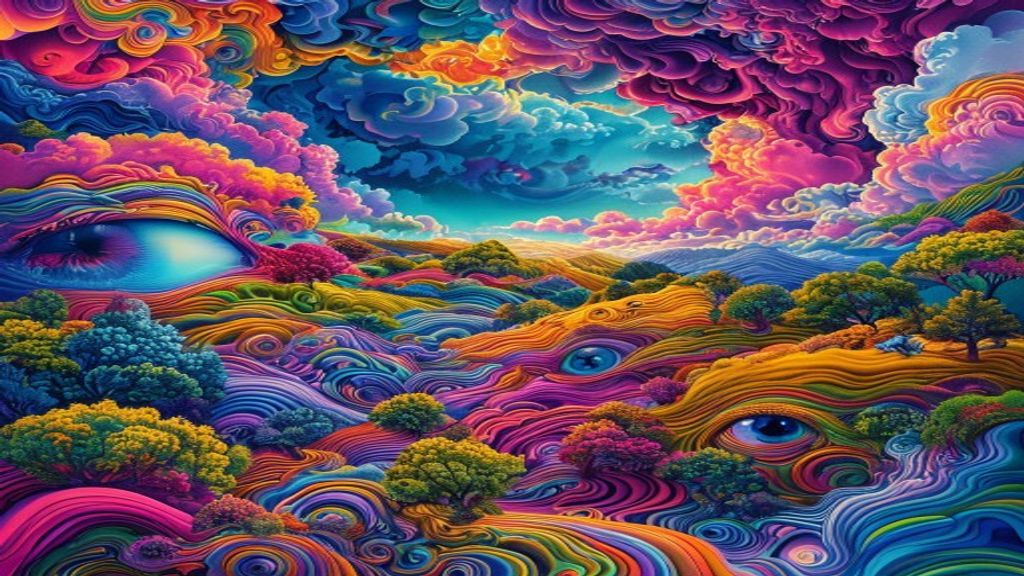
What is DeepDream? DeepDream uses a convolutional neural network trained for image recognition, but runs it in reverse:
- Start with an input image
- Ask the network: “What do you see?”
- Amplify whatever patterns the network detects
- Iterate to create hallucinogenic imagery
The Psychedelic Aesthetic:
- Eyes and faces emerging from random patterns
- Dog faces everywhere (because the training data included many dog images)
- Swirling, fractal-like textures
- Vibrant, saturated colors
- Surreal, dreamlike quality
5.2 Cultural Impact
Why DeepDream Mattered:
- First mainstream AI art: Millions of people tried it
- Visualized neural networks: Showed what AI “sees”
- Inspired artists: Became a genuine artistic movement
- Proved accessibility: You didn’t need to be a researcher
DeepDream Art Movement:
- Artists incorporated DeepDream into their workflows
- Music videos used DeepDream effects
- Fashion and design embraced the aesthetic
- It became a recognizable visual style
5.3 Technical Significance
DeepDream revealed:
- Neural networks build hierarchical features
- Lower layers detect edges and textures
- Higher layers detect objects and concepts
- The network’s “imagination” could be visualized
6. Style Transfer Breakthrough (2015)
6.1 Neural Style Transfer
Also in 2015, neural style transfer emerged as another game-changing technique.
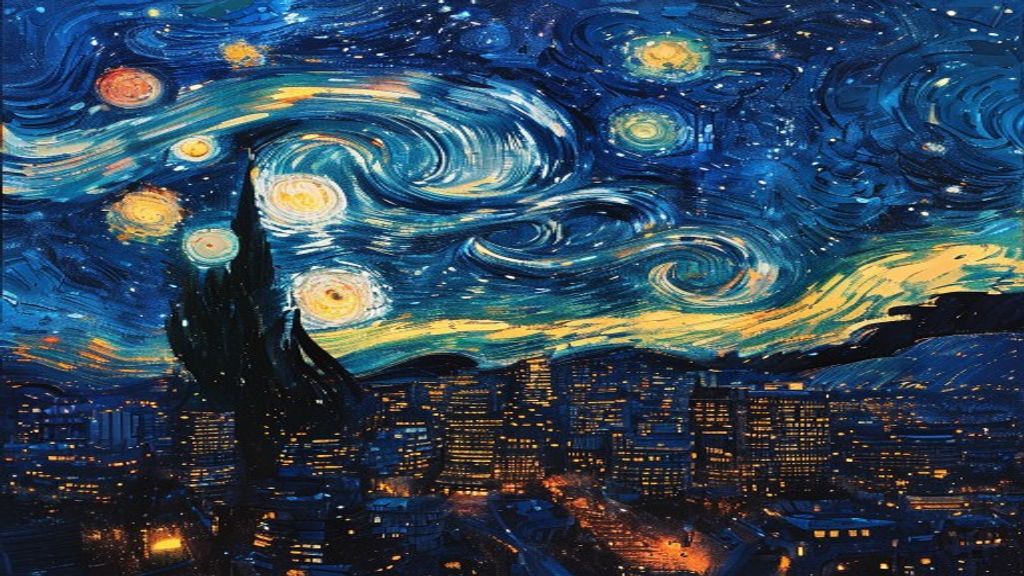
The Innovation: Separate and recombine:
- Content: What is in the image (objects, structure)
- Style: How it looks (colors, textures, brushstrokes)
How It Works:
- Extract content representation from photo
- Extract style representation from artwork
- Optimize a new image to match both
- Result: Photo content rendered in artistic style
6.2 Popular Apps and Impact
Prisma (2016):
- First mainstream style transfer app
- Dozens of artistic filters
- Real-time processing on smartphones
- Over 100 million downloads
Other Notable Apps:
- DeepArt
- Ostagram
- Artisto
- NeuralStyle
Artistic Implications:
- Anyone could create “paintings” from photos
- Raised questions about authorship and originality
- Demonstrated practical AI art applications
- Set stage for text-to-image generation
7. The Rise of Text-to-Image (2016-2020)
7.1 VQGAN+CLIP Era (2020-2021)
Before DALL-E, the AI art community experimented with VQGAN+CLIP:
VQGAN (Vector Quantized GAN):
- Generated images from compressed representations
- Higher quality than earlier GANs
- Could work at reasonable resolutions
CLIP (Contrastive Language-Image Pre-training):
- OpenAI’s model connecting text and images
- Understood natural language descriptions
- Could guide image generation toward text prompts
The Colab Notebook Phenomenon:
- Researchers shared Jupyter notebooks
- Anyone could run VQGAN+CLIP for free
- Iterative refinement became popular
- Community developed prompting techniques
Limitations:
- Slow generation (minutes per image)
- Required iterative optimization
- Results were unpredictable
- Quality varied significantly
7.2 Diffusion Models Emerge
Denoising Diffusion Probabilistic Models (DDPM) offered a new approach:
How Diffusion Works:
- Start with random noise
- Gradually denoise over many steps
- Guide denoising with text or other conditions
- Result: Clean, generated image
Advantages:
- More stable training than GANs
- Better mode coverage (more diverse outputs)
- Scalable to high resolutions
- Natural fit for conditional generation
8. Old AI Images: Then vs Now
The contrast between old AI images and modern outputs illustrates one of technology’s most dramatic creative revolutions. Understanding this comparison helps contextualize how far the field has progressed in just a few years.
8.1 The Evolution of AI Image Quality
| Era | Examples | Resolution | Realism | Control |
|---|---|---|---|---|
| 1960s-70s | Plotter drawings, AARON | Low | Abstract | Program rules |
| 2014 | First GAN faces | 32x32 - 64x64 | Blurry, surreal | Random noise |
| 2015 | DeepDream, style transfer | Same as input | Psychedelic | Limited parameters |
| 2021 | DALL-E v1 | 256x256 | Conceptual, coherent | Text prompts |
| 2022 | DALL-E 2, Midjourney, Stable Diffusion | 1024x1024 | Photorealistic possible | Detailed prompts |
| 2026 | Modern diffusion models | Up to 8K | Near-photo quality | Fine-grained editing |
8.2 Before and After: Early AI Images vs Modern AI Images
1965 vs 2026:
- Then: Black-and-white geometric lines drawn by a plotter
- Now: Full-color photorealistic portraits, landscapes, and conceptual art
2014 vs 2026:
- Then: Blurry 64x64 GAN faces with distorted features
- Now: Sharp, consistent human faces indistinguishable from photographs
2015 vs 2026:
- Then: DeepDream images where every texture turned into dog faces and eyes
- Now: Controlled, coherent compositions matching precise text descriptions
2021 vs 2026:
- Then: DALL-E’s 256x256 “avocado chair” — creative but crude
- Now: 4K product renders with perfect lighting, text, and materials
8.3 The Modern Era Begins (2020-2022)
8.3.1 2021 AI Images: DALL-E Changes Everything
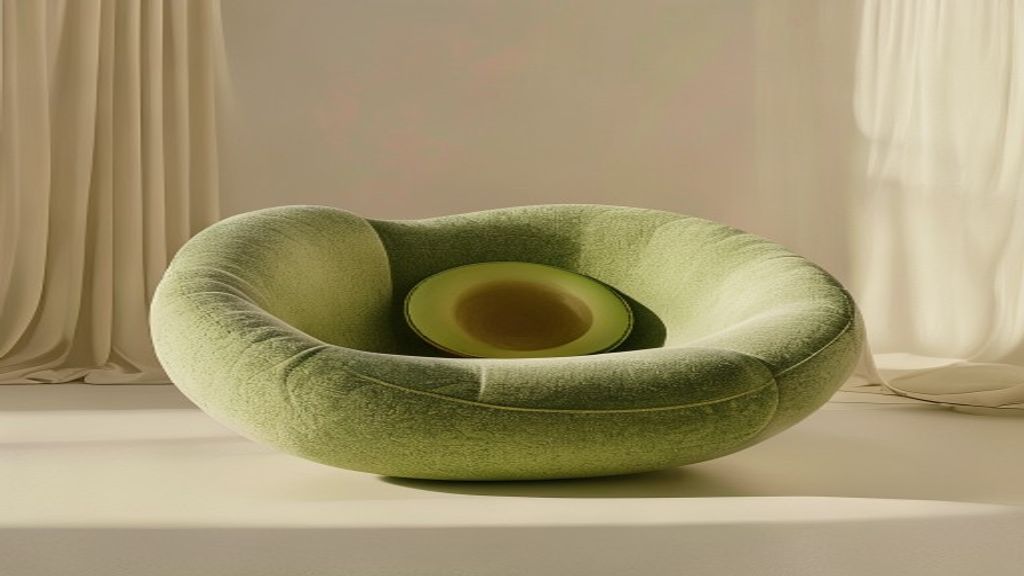
OpenAI’s DALL-E (January 2021) marked the beginning of the modern AI art era.
What Made DALL-E Revolutionary:
- Natural language understanding: Describe anything, get an image
- Conceptual combinations: “Avocado chair” became iconic
- Multiple styles: Could mimic various artistic approaches
- Surprising coherence: Objects made sense, even surreal ones
2021 AI Image Characteristics:
- 256x256 pixel resolution
- Creative concept combinations
- Sometimes garbled text
- Limited access (invite-only beta)
- Couldn’t edit or iterate easily
8.3.2 2022 AI Images: The Photorealistic Era
April 2022: DALL-E 2
- 1024x1024 resolution
- Photorealistic generation became possible
- Inpainting and outpainting capabilities
- Better text understanding
July 2022: Midjourney Beta
- Focus on artistic aesthetics
- Beautiful, painterly defaults
- Strong community on Discord
- Iterative refinement workflow
August 2022: Stable Diffusion
- Open source release
- Ran on consumer GPUs
- Enabled unlimited local generation
- Sparked explosion of tools and apps
Why 2022 Was the Tipping Point:
- Multiple high-quality tools launched within months
- Public access replaced invite-only betas
- Photorealistic outputs became routine
- AI art entered mainstream culture
8.4 Case Studies: Iconic Early AI Images
8.4.1 The First GAN Faces (2014)
What They Looked Like:
- Blurry, low-resolution (32x32 pixels)
- Distinctive artifacts around eyes and mouth
- Strange hair textures
- Often unsettling or surreal
Why They Looked That Way:
- Limited training data
- Small network capacity
- Unstable training dynamics
- Early in adversarial learning process
Significance: Despite flaws, these faces proved GANs could generate novel, somewhat realistic human images—a milestone in AI history.
8.4.2 DeepDream’s Viral Moments (2015)
Most Famous DeepDream Images:
- The Dog-Faced Sky: Clouds transformed into dog faces
- The Eye Tower: Buildings covered in eye patterns
- The Pasta Monster: Food images becoming creatures
Cultural Impact:
- Featured in mainstream media
- Used in music videos (like “Deep Dream” by Fever The Ghost)
- Inspired fashion collections
- Became a meme format
8.4.3 Early DALL-E Images (2021)
The early DALL-E images from 2021 defined the public’s first impression of text-to-image AI.
The Most Famous Early DALL-E Images:
- Avocado Chair: An armchair shaped like an avocado — the defining image of the era
- Radish Dog: A radish walking a dog in a tutu
- Pikachu Backpack: A furry yellow backpack with Pikachu ears
- Giraffe Made of Flowers: Exactly what it sounds like
- Baby Radish in a Trench Coat: Whimsical anthropomorphic characters
What Early DALL-E Images Revealed: DALL-E understood concepts surprisingly well but struggled with:
- Precise spatial reasoning
- Text rendering
- Physical consistency
- Fine details
- Realistic human faces and hands
Technical Limitations of 2021 DALL-E:
- 256x256 pixel resolution
- Garbled text in images
- Misunderstood spatial relationships
- Strange anatomy on animals
- Inconsistent lighting and shadows
Despite these flaws, early DALL-E images proved that AI could combine concepts creatively — a foundation for the photorealistic tools that followed in 2022.
8.5 Early AI Photos vs Modern AI Images: Technical Comparison
Comparing 2015 vs 2022 vs 2026:
| Aspect | 2015 (DeepDream) | 2022 (DALL-E 2/Midjourney) | 2026 (Modern Tools) |
|---|---|---|---|
| Resolution | Same as input | 1024x1024 | Up to 8K+ |
| Realism | Surreal/distorted | Photorealistic possible | Near-indistinguishable from photos |
| Control | Limited parameters | Detailed text prompts | Fine-grained editing, ControlNet |
| Coherence | Dreamlike chaos | Logical compositions | Physically accurate, consistent lighting |
| Speed | Minutes to hours | Seconds to minutes | Real-time generation |
| Access | Research only | Public availability | Free and open-source options |
| Customization | None | Limited | LoRA, custom models, style training |
9. Lessons from Early AI Art
9.1 How Limitations Shaped Modern Tools
From GANs to Diffusion:
- GAN training instability led to diffusion research
- Mode collapse problems drove diversity improvements
- Quality limitations pushed resolution increases
From DeepDream to Control:
- DeepDream’s randomness inspired controllable generation
- Visualization techniques improved interpretability
- Feature understanding enabled better guidance
9.2 The Importance of Training Data
Key Insights:
- DeepDream saw dogs everywhere because of ImageNet’s dog categories
- DALL-E’s strengths reflected its training corpus
- Bias in training data creates bias in outputs
- Data curation became as important as algorithms
9.3 Evolution of Prompt Engineering
2015: No Prompts
- DeepDream just amplified existing images
2020: Simple Keywords
- VQGAN+CLIP used basic descriptions
2021: Natural Language
- DALL-E enabled full sentence descriptions
2022: Crafted Prompts
- Users developed sophisticated techniques
- Style references, quality modifiers, negative prompts
- Prompt engineering became a skill
2026: Structured Prompting
- Multi-modal inputs (image + text)
- Style reference images
- Automated prompt optimization
- Real-time iterative refinement
9.4 Community’s Role in Advancing the Technology
Open Source Contributions:
- Stable Diffusion’s release accelerated innovation
- Community-trained models expanded capabilities
- Shared prompts and techniques raised everyone’s skills
Artistic Exploration:
- Artists pushed boundaries of what was possible
- Feedback loops improved commercial tools
- New aesthetics emerged from experimentation
10. Conclusion: From Patterns to Photorealism
The journey from 1960s computer graphics to 2026’s photorealistic AI represents one of technology’s most rapid creative revolutions. From the first AI generated image in 1965 to today’s 8K diffusion models, each decade built on the discoveries of the last.
Key Milestones:
- 1965: Frieder Nake creates the oldest computer-generated drawings
- 1973: AARON creates autonomous art
- 2014: GANs prove neural networks can generate images
- 2015: DeepDream makes AI art viral
- 2015: Style transfer democratizes artistic filters
- 2021: DALL-E introduces practical text-to-image generation
- 2022: DALL-E 2, Midjourney, and Stable Diffusion make photorealistic AI images mainstream
- 2026: 8K resolution, video generation, and real-time creation
What’s Next:
- Video generation (already emerging)
- 3D model creation
- Real-time generation
- Multimodal creativity (sound, touch, smell)
- AI-human collaborative tools
The early AI images that seemed like curiosities just years ago have become the foundation of a creative revolution. What seemed impossible in 2015 is now accessible to anyone with an internet connection. Whether you’re researching AI art history, comparing old AI images vs now, or exploring the evolution of AI images, the story is clear: machines have learned to create, and they’re only getting better.
Experience the Latest in AI Art Generation
From DeepDream’s psychedelic patterns to DALL-E’s conceptual creations, we’ve witnessed an extraordinary evolution. Now, platforms like NeoSpark bring together the best of modern AI art tools—Midjourney, Nano Banana, and more—giving you access to capabilities that would have seemed like science fiction just a few years ago.
Create Your Own AI Art History on NeoSpark →
Related Resources
Last Updated: July 20, 2026 Author: Alex Zhang, Founder of Neospark Platform Social: Follow on X
Frequently Asked Questions About Early AI Images
What was the first AI generated image?
The first computer-generated images were created in 1965 by Frieder Nake using a plotter. The first truly autonomous AI art system was Harold Cohen’s AARON (1973).
When did AI generated images start?
AI-generated images started in the 1960s as computer art. The modern neural-network era began in 2014 with GANs.
What is the oldest AI generated image?
The oldest known computer-generated images date to 1965, created by Frieder Nake and Michael Noll at Bell Labs.
When did AI images become popular?
AI images went viral in 2015 with DeepDream and Prisma, then became mainstream in 2022 with DALL-E 2, Midjourney, and Stable Diffusion.
What are early DALL-E images?
Early DALL-E images from 2021 include the famous “avocado chair,” a radish walking a dog in a tutu, and a giraffe made of flowers. They were 256x256 and often had garbled text or strange anatomy.
How do old AI images compare to modern AI images?
Old AI images (1960s-2015) were low-resolution, monochrome, and rule-based. Modern AI images (2022-2026) are photorealistic, high-resolution, and controllable through natural language.
Try It Yourself: Curated Prompts
Explore the evolution of AI art styles with these historically-inspired and artistically diverse prompts:
Retro & Vintage Styles
- Riso Print Style - Vintage print aesthetics from the 1960s-80s
- 7-Year-Old Artist Style - Naive, early computational art feel
- 3D Paper Art Style - Layered dimensional creativity
Artistic Movements & Styles
- Ethereal Fantasy Illustration - Dreamlike DeepDream-inspired aesthetics
- Character Portrait Photography - Evolution of AI portraiture
- Nature Scene Photography - Landscape complexity through AI generations
Technical Evolution
- Prompt Structure and Visual Elements - Master controlled composition
- Lighting Techniques (3 Examples) - Professional lighting evolution
- Quality Enhancement Keywords - From low-res to 8K+ quality
References:
- Harold Cohen’s AARON Documentation
- Goodfellow et al. - Generative Adversarial Networks (2014)
- Mordvintsev et al. - Inceptionism: Going Deeper into Neural Networks (2015)
- Ramesh et al. - DALL-E: Creating Images from Text (2021)
- Rombach et al. - High-Resolution Image Synthesis with Latent Diffusion Models (2022)