How to Design Travel Agency Flyers That Convert Wanderers Into Bookers
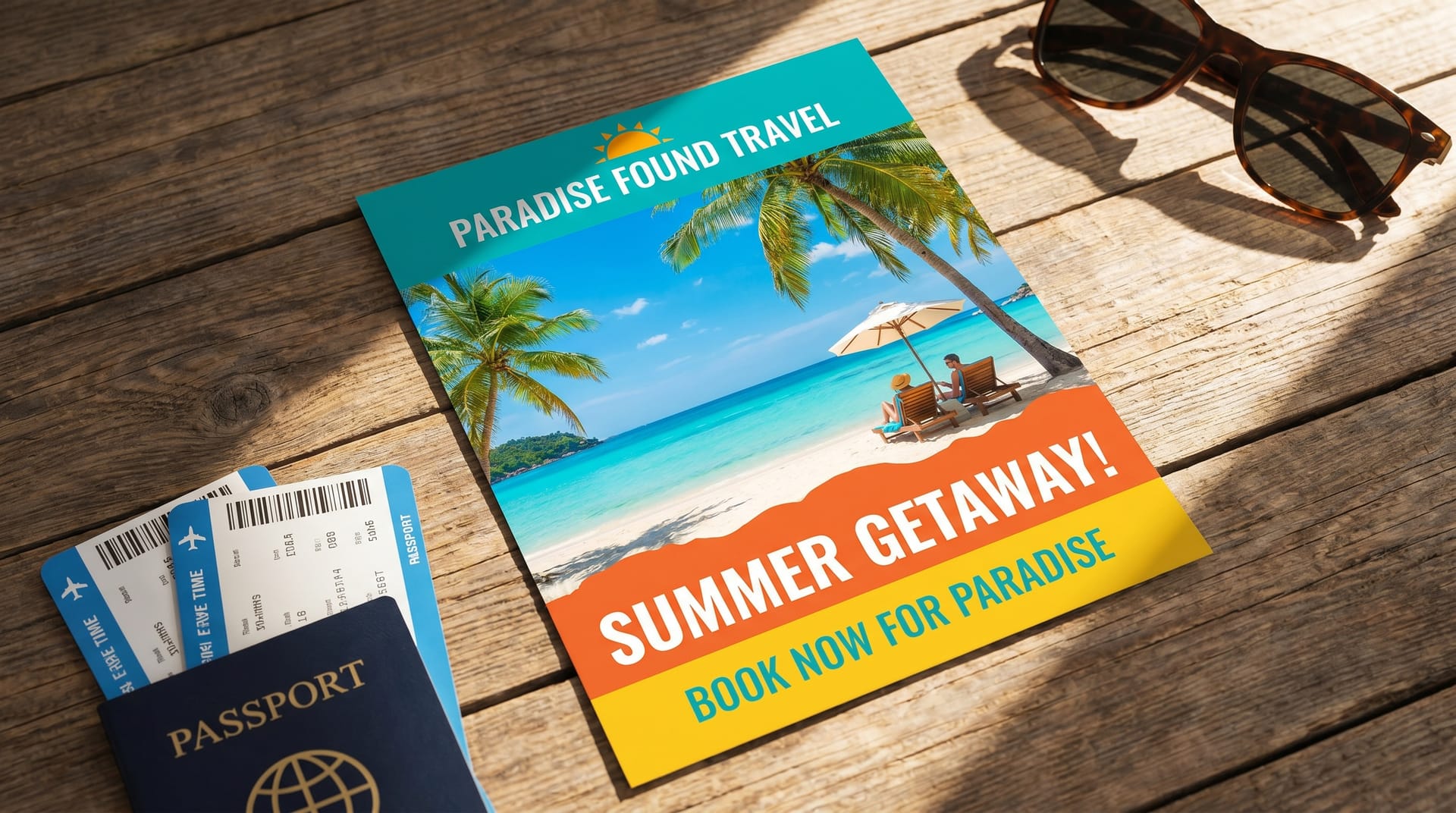
Alex Zhang is the founder of NeoSpark, an AI-powered design platform helping creators and teams generate images, videos, and brand assets without design skills.
How to Design Travel Agency Flyers That Convert Wanderers Into Bookers
TL;DR: Travel agency flyers remain one of the highest-ROI marketing tools in tourism when designed strategically. This guide covers the essential design elements, niche-specific layouts, a proven step-by-step creation process, and how AI tools like NeoSpark can cut your design time from hours to minutes while producing professional, conversion-ready flyers for every season.
Table of Contents
- Why Flyers Still Matter in Travel Marketing
- Travel Flyer Design Elements
- Flyer Types by Travel Niche
- Step-by-Step Design Process
- Print vs Digital Distribution
- AI Flyer Creation with NeoSpark
- Seasonal Travel Campaign Calendar
- Case Studies: Real Travel Agencies
- FAQ
- Conclusion
- Related Resources
Why Flyers Still Matter in Travel Marketing
In an era dominated by Instagram ads and email campaigns, the humble travel flyer might seem like a relic. But the data tells a different story. Physical and digital flyers continue to deliver exceptional returns for travel agencies, tour operators, and destination marketers who understand how to wield them.
Travel is inherently visual and emotional. A well-designed flyer does what a banner ad cannot: it creates a tangible connection to a destination. It sits on a coffee table, gets pinned to a refrigerator, or is shared in a group chat. That physical or saved-digital presence keeps your brand top-of-mind during the long consideration phase typical of travel purchases.
Consider these compelling statistics:
| Metric | Statistic | Source / Context |
|---|---|---|
| Direct Mail Response Rate | 9% for travel and hospitality sectors | Significantly higher than digital averages |
| Flyer Attention Time | Average 3-5 seconds to capture attention | Critical window for headline and imagery |
| Print + Digital Combo | 28% higher conversion than digital-only | Integrated campaigns outperform silos |
| QR Code Scan Rates on Flyers | Up to 45% increase in engagement | Bridges physical to digital seamlessly |
| Travel Decision Timeline | 60-90 days average from inspiration to booking | Flyers serve as persistent reminders |
The key insight? Flyers work because travel is a high-consideration purchase. Customers do not impulse-buy a $4,000 safari or a two-week European cruise. They dream, they plan, they compare. A beautifully designed flyer becomes a bookmark in that journey, a visual promise of the experience to come.
For travel agencies, flyers also serve a crucial local marketing function. They appear in hotel lobbies, visitor centers, coffee shops, and community boards, places where your ideal customer is already in a travel mindset. A strategically placed flyer can intercept a traveler at the exact moment they are most receptive to inspiration.
Travel Flyer Design Elements
Every high-converting travel agency flyer is built on a foundation of six essential elements. Master these, and you will create marketing assets that do not just look good, they perform.
Hero Destination Imagery
The visual is everything in travel marketing. Your hero image should not just show a destination; it should make the viewer feel the warmth of the sand, hear the bustle of the market, or smell the mountain air. Follow these guidelines:
- Choose emotion over information. A candid shot of a couple laughing at a sunset dinner outperforms a sterile resort facade every time.
- Use authentic, diverse imagery. Modern travelers want to see themselves in the experience. Represent a range of ages, body types, and ethnicities.
- Prioritize faces and action. Neuroscience confirms that human faces and movement draw the eye faster than static landscapes.
- Maintain image quality. Use high-resolution photos (300 DPI for print) with professional color grading. Nothing undermines credibility like a pixelated beach.
Compelling Headline
Your headline has three seconds to stop a scroll or a walk-by. It must be specific, benefit-driven, and emotionally resonant.
Weak: “Visit Bali This Summer” Strong: “Bali: 7 Nights in Paradise From $899, Flights Included”
The strong headline includes the destination, the duration, the price anchor, and a value proposition. It answers the customer’s silent question: “What do I get, and what will it cost me?”
Price/Offer Callout
Travel is a price-sensitive category. Your offer must be impossible to miss. Use contrasting colors, bold typography, and generous white space to make your price or promotion the visual anchor of your flyer.
Best practices:
- Display the total package price prominently, not just “from” rates
- Show the original price struck through next to the promotional price
- Include what is included (flights, hotels, meals, tours) to justify value
- Add a clear expiration date to create urgency
Trust Signals (Reviews, Awards)
Travel involves risk. Customers hand over significant money and put their precious vacation time in your hands. Trust signals reduce perceived risk and accelerate the decision.
Effective trust signals for travel flyers:
- TripAdvisor or Google review scores (“4.8/5 Stars from 340 Travelers”)
- Industry awards or certifications (ASTA member, IATA accredited)
- “As Seen In” media logos (Travel + Leisure, Cond�� Nast Traveler)
- Satisfaction guarantees or “No Hidden Fees” promises
- Real customer testimonials with names and trip details
Contact/QR Code
Every flyer must have a frictionless path to action. In 2026, that means blending traditional contact methods with smart digital shortcuts.
Include:
- A scannable QR code linking directly to the booking page or a detailed itinerary PDF
- Your phone number in large, readable type
- Your website URL, kept short with a vanity domain if possible
- Social media handles for credibility and community proof
- Physical address if you operate a walk-in agency
Pro tip: Use dynamic QR codes so you can track scans by campaign, adjust landing pages, and retarget scanners with digital ads.
Limited-Time Urgency
Scarcity and urgency are powerful psychological triggers in travel marketing. When a deal feels fleeting, the dream vacation transforms from “someday” to “book now.”
Effective urgency tactics:
- “Book by May 15, Save $400”
- “Only 12 Rooms Left at This Price”
- “Early Bird Pricing Ends Friday”
- “Exclusive to First 50 Bookings”
Be truthful. Manufactured urgency destroys trust. If you say only 12 rooms remain, ensure that is accurate.
Flyer Types by Travel Niche
Not all travel flyers are created equal. The design, messaging, and imagery must align with the specific niche you are promoting. Here is how to tailor your approach.
Beach/Vacation Packages
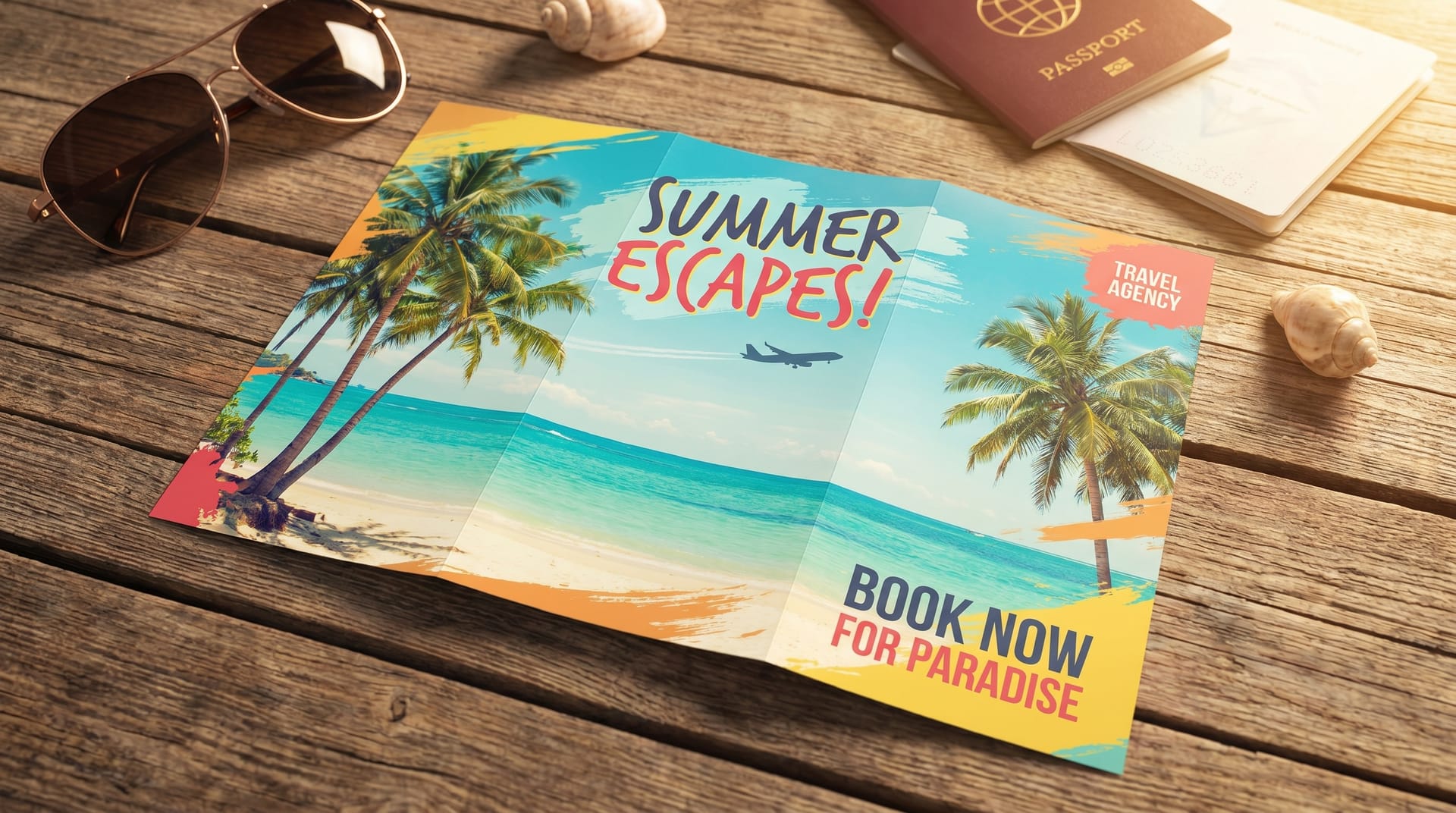
Beach flyers should radiate relaxation and escape. Use expansive horizon shots, turquoise water, and warm sunset tones. The messaging should emphasize ease: “Everything included,” “Zero planning required,” “Just show up and unwind.”
Design notes:
- Horizontal layouts work well to showcase wide beach vistas
- Use script or rounded sans-serif fonts for a relaxed feel
- Include resort amenities icons (pool, spa, Wi-Fi, all-inclusive)
- Feature family-friendly or couples-only positioning clearly
Adventure Tours
Adventure flyers must pulse with energy and possibility. Think dramatic angles, action shots, and bold, rugged typography. Your audience is seeking challenge and transformation, not just a vacation.
Design notes:
- Use diagonal layouts and dynamic compositions
- Feature difficulty ratings and physical requirements honestly
- Highlight group sizes (small group intimacy is a selling point)
- Include guide credentials and safety certifications
Cruise Promotions
Cruise flyers balance the ship experience with destination variety. The unique value proposition is “unpack once, see it all.” Your design should convey abundance and effortless exploration.
Design notes:
- Split layouts showing the ship and a destination highlight
- Use elegant, refined typography suggesting premium service
- Include itinerary maps as visual anchors
- Feature dining, entertainment, and cabin category options
Business Travel
Business travel flyers prioritize efficiency, reliability, and value. The audience is not dreaming, they are solving a logistics problem. Design should be clean, professional, and information-dense.
Design notes:
- Use corporate color palettes (navy, gray, white with accent colors)
- Lead with time-saving benefits and 24/7 support
- Include corporate account benefits and volume pricing
- Feature testimonials from business clients in recognizable industries
Group Tours
Group tour flyers sell community and shared experience. The design should feel social and welcoming, emphasizing the joy of traveling with like-minded people.
Design notes:
- Feature group photos showing genuine camaraderie
- Highlight group size limits and demographic targeting (“Women 30-50,” “Solo Travelers Welcome”)
- Include trip leader photos and bios
- Use warm, inclusive color palettes
Step-by-Step Design Process
Creating a travel flyer from concept to distribution does not need to be overwhelming. Follow this proven workflow to produce professional results consistently.
Step 1: Define Your Objective and Audience
Before opening a design tool, answer these questions:
- What specific action do I want the viewer to take? (Call, book online, visit the office, join a mailing list?)
- Who is the ideal traveler for this offer? (Age, income, travel style, pain points)
- What is the single most compelling reason to book this trip now?
Step 2: Gather Your Assets
Collect everything you need before designing:
- High-resolution destination photos (5-10 options)
- Logo files in vector format
- Brand color codes and font files
- Copy: headline, body text, offer details, terms and conditions
- Trust signals: reviews, awards, certifications
- QR code and tracking links
Step 3: Choose Your Format and Layout
Standard flyer sizes:
- US Letter (8.5 x 11 in): Most versatile, ideal for posting and handouts
- A4 (210 x 297 mm): International standard
- Half-letter (5.5 x 8.5 in): Cost-effective for bulk distribution
- DL (99 x 210 mm): Perfect for rack cards and hotel lobby displays
- Square (6 x 6 in or 8 x 8 in): Social-media friendly for digital flyers
Select a layout that matches your content hierarchy. Will the image dominate? Will the offer be the hero? Sketch a rough wireframe first.
Step 4: Build in Your Design Tool
Whether you use Adobe InDesign, Canva, or an AI-powered platform like NeoSpark, follow these principles:
- Establish a clear visual hierarchy with size, color, and contrast
- Use no more than two font families
- Maintain generous margins (at least 0.25 inches for print)
- Ensure all text meets WCAG contrast standards
- Place your call-to-action above the fold
Step 5: Review and Refine
Print a test copy or view the digital version on multiple devices. Check:
- Is the headline readable from 6 feet away?
- Does the QR code scan correctly?
- Are all dates, prices, and terms accurate?
- Does the design feel cohesive and on-brand?
- Is there any visual clutter that could be removed?
Step 6: Export for Distribution
For print: Export as PDF/X-1a with bleed (0.125 inches) and crop marks. Use CMYK color mode. For digital: Export as PNG or JPEG at 72-150 DPI. Use RGB color mode. Create multiple aspect ratios for different platforms.
Step 7: Distribute and Track
Deploy your flyer through your chosen channels. Use unique QR codes, promo codes, or landing page URLs for each distribution method so you can measure what works.
Print vs Digital Distribution
The modern travel agency does not choose between print and digital. The smartest operators use both, strategically. Here is how they compare.
| Factor | Print Flyers | Digital Flyers |
|---|---|---|
| Cost Per Unit | $0.15 - $1.50 depending on quality and volume | Near-zero marginal cost |
| Targeting | Geographic and contextual (hotel lobbies, visitor centers) | Demographic, behavioral, and interest-based |
| Tangibility | High: physical presence, refrigerator-worthy | Low: easily scrolled past or deleted |
| Tracking | QR codes, promo codes, phone number extensions | Pixel tracking, click-through rates, heatmaps |
| Update Speed | Slow: requires reprinting | Instant: edit and redeploy in minutes |
| Best Use Case | Local presence, high-value packages, event handouts | Rapid testing, social campaigns, email embeds |
| Environmental Impact | Higher: paper, ink, transport | Lower: digital-only footprint |
Our recommendation: Use digital flyers for rapid A/B testing and broad reach. Convert your winning designs to print for high-impact local distribution and premium package promotions.
AI Flyer Creation with NeoSpark
Designing travel flyers used to require expensive software, specialized skills, or outsourcing to agencies that take days to deliver. NeoSpark changes the equation entirely.
NeoSpark is an AI-powered design platform built for marketers who need professional visual assets without the professional design background. For travel agencies, it offers specific advantages:
Speed to Market
In travel, timing is everything. A flash sale on Bali packages or a last-minute cruise cancellation deal needs to go out today, not next week. NeoSpark generates complete, brand-aligned flyer designs in under 60 seconds from a simple text prompt. Describe your offer, and the AI handles layout, imagery selection, typography, and color harmony.
Niche-Aware Templates
NeoSpark’s template library includes travel-specific layouts optimized for different niches: beach getaways, adventure expeditions, luxury cruises, corporate travel, and group tours. Each template incorporates the design principles that convert in that specific category.
Brand Consistency at Scale
Upload your logo, brand colors, and preferred fonts once. NeoSpark applies them automatically across every flyer, ensuring your agency looks polished and professional whether you are creating one flyer or fifty for different destinations.
Smart Content Suggestions
Stuck on a headline? NeoSpark analyzes your destination, offer, and audience to suggest compelling copy options. It knows that “Adventure Awaits in Patagonia” outperforms “Visit Patagonia” because it is trained on conversion-optimized travel marketing language.
Multi-Format Export
Create once, distribute everywhere. NeoSpark exports your flyer in print-ready PDF, social-optimized PNG, email-friendly JPEG, and even animated digital versions for Instagram Stories and TikTok. No recreating, no reformatting.
Collaboration and Approval
Share designs with team members or clients for feedback directly in the platform. Comment, revise, and approve without endless email chains or version confusion.
For travel agencies looking to produce more marketing with fewer resources, NeoSpark transforms flyer creation from a bottleneck into a competitive advantage.
Seasonal Travel Campaign Calendar
Smart travel marketers plan their flyer campaigns around seasonal demand patterns. Here is a year-round calendar to keep your pipeline full.
| Season | Campaign Focus | Flyer Theme | Timing |
|---|---|---|---|
| Winter (Jan-Feb) | Escape the cold: Caribbean, Southeast Asia, ski packages | Warmth, sunshine, contrast with gray skies | Launch December, peak January |
| Spring (Mar-Apr) | Spring break, European city breaks, cherry blossom tours | Renewal, blooming destinations, family fun | Launch February, peak March |
| Summer (May-Jun) | Early booking for fall, Mediterranean cruises, Alaska | Adventure, long days, outdoor exploration | Launch April, peak May |
| Peak Summer (Jul-Aug) | Last-minute summer deals, back-to-school travel | Urgency, limited availability, final chance | Launch June, peak July |
| Fall (Sep-Oct) | Fall foliage, wine tours, off-peak European travel | Color, harvest, cozy experiences, value | Launch August, peak September |
| Holiday (Nov-Dec) | Holiday gift trips, New Year escapes, tropical Christmas | Gift-giving, celebration, once-in-a-lifetime | Launch October, peak November |
Plan your flyer designs at least six weeks before each campaign launch. This gives you time for creation, approval, printing (if needed), and distribution setup.
Case Studies: Real Travel Agencies
Case Study 1: Horizon Travel Co. �� From Brochure Wallflower to Flyer Powerhouse
Horizon Travel Co., a mid-sized agency in Denver specializing in adventure travel, was struggling with stagnant bookings. Their marketing relied on generic brochures that blended into the background of every visitor center and coffee shop.
The Challenge: Horizon’s brochures tried to be everything to everyone. They listed 40 destinations in small type with tiny thumbnail images. Nothing stood out. Nothing inspired action.
The Solution: Horizon partnered with NeoSpark to overhaul their approach. Instead of one generic brochure, they created a series of niche-specific flyers:
- “Patagonia Trek: 10 Days, $2,499” with a dramatic mountain hero shot
- “Costa Rica Adventure: Zip, Raft, Surf” with action photography
- “Iceland Northern Lights: November-March” with aurora imagery
Each flyer followed the six-element framework: hero imagery, compelling headline, clear price, trust signals (their 4.9 Google rating), QR code to a detailed itinerary, and limited-time urgency.
The Results:
- 340% increase in flyer-driven inquiries within three months
- 28% higher conversion rate from inquiry to booking for flyer leads vs. other channels
- Cost per lead dropped by 52% compared to their previous Google Ads campaigns
- Most surprisingly, the Patagonia flyer became a keepsake. Customers brought it to the office when booking, saying they had pinned it to their vision board for weeks.
Key Takeaway: Specificity sells. A flyer for one incredible trip outperforms a brochure for forty average ones.
Case Study 2: Seaside Escapes �� Digital-First Flyer Strategy
Seaside Escapes, a boutique agency in Miami focused on Caribbean and Mediterranean cruises, had no physical location. They operated entirely online but found that digital ads alone were not building the emotional connection needed for high-ticket cruise bookings.
The Challenge: Without a storefront, Seaside Escapes had no natural distribution point for print materials. Their digital ads were generating clicks but not conversions. The consideration phase for a $5,000+ cruise was too long for a single ad impression to close.
The Solution: Seaside Escapes adopted a digital-first flyer strategy using NeoSpark. They created visually stunning flyers designed for screens, not printers. These were distributed through:
- Email campaigns with embedded flyer images
- Instagram and Facebook posts and Stories
- Pinterest pins linking to booking pages
- Retargeting ads featuring the same flyer designs
Each digital flyer included a dynamic QR code that changed based on the platform, allowing precise attribution. They created seasonal variations: “Caribbean Christmas Cruise,” “Mediterranean Summer Voyage,” “Alaska Glacier Expedition.”
The Results:
- Email open rates increased 47% when flyer images were embedded vs. text-only emails
- Social media engagement (shares, saves, comments) tripled with flyer posts vs. standard promotional posts
- The Pinterest strategy was a breakthrough: cruise flyers were saved an average of 12 times each, creating a long-tail discovery effect
- Overall booking volume increased 65% year-over-year, with 40% of new customers citing “saw your flyer on Pinterest/Instagram” as their first touchpoint
Key Takeaway: Digital flyers can be persistent, shareable, and discoverable in ways print cannot. The key is designing for the platform, not simply repurposing print layouts.
FAQ
How much does it cost to design a professional travel agency flyer?
Professional flyer design from a freelance designer typically ranges from $150 to $500 per flyer, while agencies may charge $500 to $2,000. With AI design tools like NeoSpark, you can create professional-quality flyers for a fraction of that cost, often with unlimited designs included in a monthly subscription. The real savings come from speed: what used to take days now takes minutes.
What size should a travel agency flyer be?
The most versatile size is US Letter (8.5 x 11 inches) or A4 (210 x 297 mm) for general use. For hotel lobby displays and rack cards, DL size (99 x 210 mm) works best. For social media digital flyers, square formats (1080 x 1080 pixels) and Stories formats (1080 x 1920 pixels) are optimal. Always design for your primary distribution channel first, then adapt.
How do I make my travel flyer stand out?
Three principles: specificity, emotion, and clarity. Be specific about the destination, duration, and price. Use imagery that evokes emotion, not just information. And make your call-to-action so clear that a distracted viewer knows exactly what to do in two seconds. Avoid clutter. One strong message beats ten weak ones.
Should I include pricing on my travel flyer?
Generally, yes. Travel is a price-sensitive category, and hiding pricing creates friction. Display your package price prominently, but always include what is included to justify the value. If you offer multiple tiers, show the most popular package price and add “Packages from $X” for range context. Transparency builds trust.
How can I track if my flyers are working?
Use unique tracking mechanisms for each campaign: dynamic QR codes (track scans by source), unique promo codes (“FLYER50”), dedicated phone extensions, and campaign-specific landing pages. For digital flyers, use UTM parameters on all links. Compare cost per lead and conversion rate across channels to optimize your spend.
Can I use stock photos on travel flyers?
Yes, but choose wisely. Generic, overused stock photos (the laughing salad couple, the perfectly posed yoga-on-the-beach shot) undermine credibility. Invest in premium stock from sources like Unsplash, Pexels, or paid libraries like Stocksy. Better yet, use your own customer photos (with permission) or hire a photographer for your top destinations. Authenticity converts.
How often should I update my travel flyers?
Update pricing and availability in real-time using digital flyers with dynamic content. For print, refresh designs seasonally to stay relevant. Even if the offer is similar, new imagery and seasonal messaging keep your marketing fresh. A good rule: new creative every quarter, with real-time updates for digital.
Conclusion
Travel agency flyers are far from obsolete. In a world of fleeting digital impressions, a well-designed flyer, whether printed and pinned to a board or saved and shared on social media, creates a lasting connection between your customer and their dream destination.
The agencies winning in 2026 are not choosing between print and digital. They are using both, strategically, with designs that respect the traveler’s journey from inspiration to booking. They are specific rather than generic. Emotional rather than informational. And they are leveraging AI tools to produce more high-quality creative in less time than ever before.
6 Key Takeaways
-
Specificity converts. One destination, one offer, one clear call-to-action always outperforms a catalog approach.
-
Lead with emotion. Your hero image and headline should make the viewer feel the destination before they read a single detail.
-
Build trust aggressively. Reviews, awards, guarantees, and transparent pricing reduce the perceived risk of booking.
-
Bridge physical and digital. QR codes and unique tracking links turn every flyer into a measurable, interactive touchpoint.
-
Design for your niche. Beach vacations, adventure tours, and business travel each demand distinct visual language and messaging.
-
Use AI to scale. Platforms like NeoSpark let you produce professional, brand-consistent flyers in minutes, not days, freeing you to focus on strategy and customer relationships.
The world is waiting. Your customers are dreaming. Give them a flyer worth pinning to their vision board.
Related Resources
- NeoSpark AI Design Platform �� Create professional travel flyers in minutes with AI-powered design tools
- The Complete Guide to Travel Marketing �� Strategies for promoting your travel agency across every channel
- How to Design Event Flyers That Drive Attendance �� Apply flyer design principles to your travel events and open houses
- Seasonal Marketing Calendar Template �� Plan your year of travel campaigns with our free downloadable template
- QR Code Best Practices for Marketers �� Maximize scan rates and track attribution across all your flyer campaigns
- Travel Brand Identity Guide �� Build a cohesive visual brand that makes every flyer instantly recognizable