17 Proven Online Course Marketing Ideas to Sell More in 2026

Alex Zhang is the founder of NeoSpark, an AI-powered design platform helping creators and teams generate images, videos, and brand assets without design skills.
17 Proven Online Course Marketing Ideas to Sell More in 2026
TL;DR: Most online courses fail because creators build first and market second. The winning formula is simple: validate demand with a waitlist, nurture leads with free content, launch with urgency, then evergreen your funnel. This guide gives you 17 specific online course marketing ideas��from pre-launch waitlists to AI-powered visual assets��so you can fill your course without spending a dollar on ads until you know it will sell.
Table of Contents
- Why Most Courses Fail at Marketing
- Pre-Launch Marketing Strategies
- Launch Marketing Tactics
- Evergreen Marketing Strategies
- Content Marketing for Courses
- Visual Marketing Assets
- Marketing Funnel Optimization
- Case Studies: Successful Course Launches
- Frequently Asked Questions
- Conclusion
- Related Resources
Why Most Courses Fail at Marketing
Here is the uncomfortable truth: the market does not care how much time you spent recording lessons. It cares whether your course solves a painful, expensive problem for a specific person.
Most course creators follow a broken playbook. They spend three months building the perfect curriculum, record dozens of videos, build a membership site, and then announce it to crickets. The problem is not the course quality. It is the marketing sequence��or the complete absence of one.
| Mistake | Why It Kills Sales | The Fix |
|---|---|---|
| Building before validating | You create a product nobody asked for. | Sell the idea first; build after pre-sales. |
| No email list | You rely on algorithms that change overnight. | Start a waitlist 60�C90 days before launch. |
| Generic messaging | "Transform your life" means nothing to anyone. | Speak to one avatar with one specific outcome. |
| One-and-done launch | Revenue dies after the initial announcement. | Build an evergreen funnel for continuous sales. |
| Ignoring visual assets | Poor design signals poor quality. | Invest in professional landing pages and ads. |
The creators who win treat their course like a product business. They validate, pre-sell, launch with momentum, and then automate. The following online course marketing ideas are organized exactly in that order.
Pre-Launch Marketing Strategies
Pre-launch is where you manufacture demand. If you skip this phase, your launch day will feel like shouting into a void. Here are three foundational online course marketing ideas to execute before you ever open the cart.
Waitlist Building
A waitlist is the ultimate validation tool. It proves people will raise their hand and say, “Yes, I want this.” More importantly, it gives you a direct line to your hottest prospects.
How to build a high-converting waitlist:
- Create a simple landing page with one headline, three bullet points describing the transformation, and an email capture form. No video required.
- Drive traffic through content you are already creating. Add a CTA at the end of every blog post, podcast episode, or YouTube video.
- Use a referral loop with tools like Viral Loops or SparkLoop. Give waitlist members a bonus��an extra mini-course, a template, or early access��for every friend they refer.
- Segment by intent with a one-question survey after signup. Ask, “What is your biggest challenge with [topic]?” Use the answers to write your sales copy.
Aim for at least 500 waitlist subscribers before you announce your launch date. If you cannot get 500 people interested in a free waitlist, you will struggle to sell a paid course.
Free Content Funnel
Your free content is your sales team working 24/7. The goal is not to give away the entire course. It is to teach the what and the why for free, then sell the how inside your course.
The 3-layer content funnel:
- Awareness content (top of funnel): Short-form videos, tweets, LinkedIn posts, and SEO blog articles that attract your ideal student. Address the symptoms of their problem.
- Education content (middle of funnel): Long-form YouTube tutorials, podcast episodes, and downloadable guides that establish your authority. Teach frameworks and principles.
- Conversion content (bottom of funnel): Case studies, webinars, and free mini-challenges that demonstrate your methodology and naturally lead to your paid offer.
Each layer should include a clear next step. A blog post links to a guide. A guide invites readers to a webinar. A webinar presents the course. This is how you move strangers to buyers without ever feeling salesy.
Beta Tester Community
Beta testers are your secret weapon. They give you testimonials, refine your curriculum, and become your most vocal advocates.
How to run a beta program that fuels your launch:
- Recruit 20�C50 committed students from your waitlist or audience. Charge a nominal fee��$50 to $200. Free beta testers do not take action; paying testers do.
- Run the beta live over 4�C6 weeks with weekly calls. This creates urgency and lets you refine content based on real questions.
- Collect video testimonials at week 3, when momentum is highest. Ask specific questions: “What specific result have you achieved?” Generic praise is useless; specific outcomes sell.
- Turn your best beta students into affiliates. They have already experienced the transformation. Their recommendation carries more weight than any ad you could run.
The beta phase is not just about improving the course. It is about creating the social proof you need for a high-converting launch.
Launch Marketing Tactics
Launch week is where you convert months of pre-launch effort into revenue. The key is creating urgency, removing friction, and showing up everywhere your audience is.
Email Sequences
Email is still the highest-ROI channel for course launches. A well-structured launch sequence can generate 30�C50% of your total sales.
The 7-day launch email sequence:
- Day -2 (Waitlist early access): Give your waitlist 48 hours of exclusive access. This rewards loyalty and creates early social proof.
- Day 1 (Cart open): Announce the launch with a clear deadline. Focus on the transformation, not the features. Include a testimonial from your beta.
- Day 2 (Objection crusher): Address the #1 objection your audience has. Price? Time? Skepticism? Tackle it head-on with a story or case study.
- Day 4 (FAQ + bonus stack): Send your most comprehensive email. List every module, every bonus, every guarantee. Pile on value until the offer feels like a no-brainer.
- Day 6 (Scarcity reminder): 24 hours left. Share a countdown timer. Include a voice note or short video to increase personal connection.
- Day 7 (Final hours): Two emails��one at 8 AM, one at 6 PM. The morning email is a reminder. The evening email is a direct, personal nudge to the people who clicked but did not buy.
Write every email to one person. Use their name if your platform supports it. Segment based on behavior��people who clicked pricing get different messaging than people who never opened.
Social Media Countdown
Your launch should dominate your social feeds for 7�C10 days. Not by being spammy, but by telling a compelling story.
The countdown content calendar:
- 10 days out: Tease the problem your course solves. Use a personal story about your own struggle.
- 7 days out: Reveal the transformation. “In 6 weeks, my student Sarah went from X to Y. Here is how.”
- 5 days out: Behind-the-scenes content. Show your course platform, lesson thumbnails, or your messy recording setup. Humanize the process.
- 3 days out: Social proof avalanche. Share beta testimonials, screenshots of student wins, and DMs from grateful learners.
- 1 day out: Final reminder with a strong CTA. Make it absurdly easy to buy��link in bio, pinned post, story swipe-up.
- Final 6 hours: Urgency posts. “Doors close at midnight. Here is what you miss if you wait.”
Use carousels on LinkedIn and Instagram. They get 2�C3x the engagement of single images. Design them quickly with NeoSpark’s AI-powered social templates so every slide looks professional.
Webinar or Challenge
A live event compresses the buyer journey from weeks into 60�C90 minutes. It is the closest thing to a 1-on-1 sales call at scale.
The perfect webinar formula:
- 20% story: Your origin story and why you are qualified to teach this.
- 40% teaching: One high-value framework your audience can use immediately. Do not hold back. Generosity builds trust.
- 20% case study: A detailed before-and-after of a student who followed your method.
- 20% offer: Present your course as the accelerated path to the result they just saw. Include bonuses, pricing, and a fast-action discount.
Alternatively, run a 3�C5 day challenge. Each day delivers a small win. On the final day, present the course as the system that makes those wins permanent. Challenges have higher attendance than webinars because the daily commitment is smaller.
Affiliate Partnerships
Affiliates multiply your reach without multiplying your ad spend. One well-chosen partner can drive more sales than a month of organic posting.
How to recruit and activate affiliates:
- Start with your beta students and past clients. They know your work and can speak authentically.
- Reach out to complementary creators. If you teach Facebook ads, partner with someone who teaches copywriting. Same audience, different offer.
- Offer 30�C50% commission. This is standard for digital courses. High-ticket programs can go higher.
- Give affiliates everything they need: swipe copy, email templates, social graphics, and a unique tracking link. The easier you make it, the more they will promote.
- Run an affiliate leaderboard with prizes for top performers. Competition drives extra effort.
Early Bird Pricing
Price anchoring is one of the most powerful psychological triggers in online course marketing. Early bird pricing gives hesitant buyers a reason to act now instead of “thinking about it.”
Early bird pricing strategies that work:
- Founding member rate: 40�C50% off for the first 48 hours. Position it as a thank-you for early believers, not a discount.
- Fast-action bonuses: Instead of discounting, add value. The first 50 buyers get a 1-on-1 call, a template library, or lifetime access to a community.
- Payment plans with a catch: Offer a payment plan, but the early bird price is only available for pay-in-full purchases. This increases cash flow and commitment.
- Deadline enforcement: Actually close the early bird price. If you extend it, you train your audience to ignore your deadlines forever.
Evergreen Marketing Strategies
A live launch is exhilarating, but it is also exhausting. Evergreen marketing turns your course into a revenue-generating asset that sells while you sleep.
Key evergreen tactics:
- Evergreen webinar funnel: Run a recorded webinar on a loop. New leads watch, learn, and buy on autopilot. Refresh the recording every 6 months.
- SEO content engine: Publish one optimized blog post or YouTube video per week targeting keywords your audience searches. Over 12�C18 months, this becomes your most consistent traffic source.
- Email automation: Build a nurture sequence for new subscribers. Deliver value for 2�C3 weeks, then present your course. Tag buyers so they stop receiving promotional emails.
- Retargeting ads: Install the Meta Pixel and run low-budget retargeting campaigns to people who visited your sales page but did not buy. A simple “Still thinking it over?” ad can recover 5�C10% of lost sales.
- Upsells and order bumps: Increase average order value with a related template, coaching call, or community access at checkout. These small additions can add 20�C30% to total revenue.
The goal of evergreen marketing is to make every new lead valuable, even if they do not buy immediately. Plant seeds today that harvest for years.
Content Marketing for Courses
Content marketing is the engine behind every sustainable course business. It builds trust at scale and attracts the exact people who need your course.
Blogging
A strategic blog is your 24/7 salesperson. Target keywords your audience searches when they are problem-aware but solution-agnostic.
Blog topics that drive course sales:
- “How to [achieve result] without [common pain point]”
- “The complete guide to [your topic] for beginners”
- “[Number] mistakes most people make with [topic]”
- “[Topic] vs [Alternative]: which is right for you?”
Every post should end with a content upgrade��a checklist, template, or mini-guide that captures emails. That email becomes the start of your funnel.
Podcasting
You do not need your own podcast to benefit from podcast marketing. Guest on shows your audience already listens to.
The guest podcast strategy:
- Pitch 10�C15 podcasts per month. Focus on shows with 1,000�C10,000 downloads per episode. Mega-shows are hard to book; mid-tier shows have engaged audiences.
- Prepare 3�C5 stories that demonstrate your expertise without pitching. The host will naturally ask about your course.
- Create a dedicated landing page for each podcast appearance. “Go to neospark.ai/podcastname for the free guide I mentioned.” Track which shows drive the most leads.
YouTube
YouTube is the second-largest search engine in the world. Tutorial content ranks for years and builds know-like-trust faster than any other platform.
YouTube content pillars for course creators:
- How-to tutorials: Teach 80% of a skill in one video. The remaining 20% lives in your course.
- Student case studies: Interview successful students. Let them sell your course for you.
- Myth-busting: Debunk common misconceptions in your niche. Controversy drives views and comments.
- Tool reviews and comparisons: People searching for software reviews are often looking for training on how to use those tools.
Optimize every video title, description, and thumbnail for clicks. A great video with a bad thumbnail gets zero views.
Visual Marketing Assets
In a crowded market, professional design is not a luxury. It is a trust signal. Your visual assets tell potential students whether your course is worth their money before they read a single word.
Landing Pages
Your course landing page has one job: convert visitors into buyers. Every element should serve that goal.
Landing page essentials:
- Headline: Lead with the transformation. “Learn Python in 30 Days” is weaker than “Build Your First App and Land a Junior Developer Job.”
- Hero image or video: Show the outcome, not the product. A smiling student holding a certificate beats a screenshot of your course platform.
- Social proof section: Testimonials, student counts, ratings, and media logos. Stack proof until it is undeniable.
- FAQ section: Address objections before they become reasons to leave.
- Guarantee: A 30-day money-back guarantee reduces perceived risk and increases conversions.
Design your landing page with NeoSpark’s AI landing page builder. Choose from conversion-optimized templates, customize colors and fonts in seconds, and publish without touching a line of code.
Ads and Social Graphics
Your ads compete against cat videos and vacation photos for attention. They must stop the scroll.
High-performing ad creative principles:
- One message per ad: Do not try to sell the entire course in one image. Sell the webinar. Sell the free guide. Sell the transformation.
- Faces win: Ads with human faces consistently outperform graphics-only ads. Use photos of yourself or your students.
- Contrast and bold text: Your headline must be readable on a phone screen without zooming.
- Motion beats static: Video ads, even simple slideshows, get more engagement than still images.
Create scroll-stopping ad creatives and social graphics with NeoSpark. Generate dozens of variations from a single prompt, resize automatically for every platform, and maintain brand consistency across all your marketing channels.
Marketing Funnel Optimization
Your funnel is the journey a stranger takes from first hearing about you to buying your course. Small improvements at each stage create massive revenue gains.
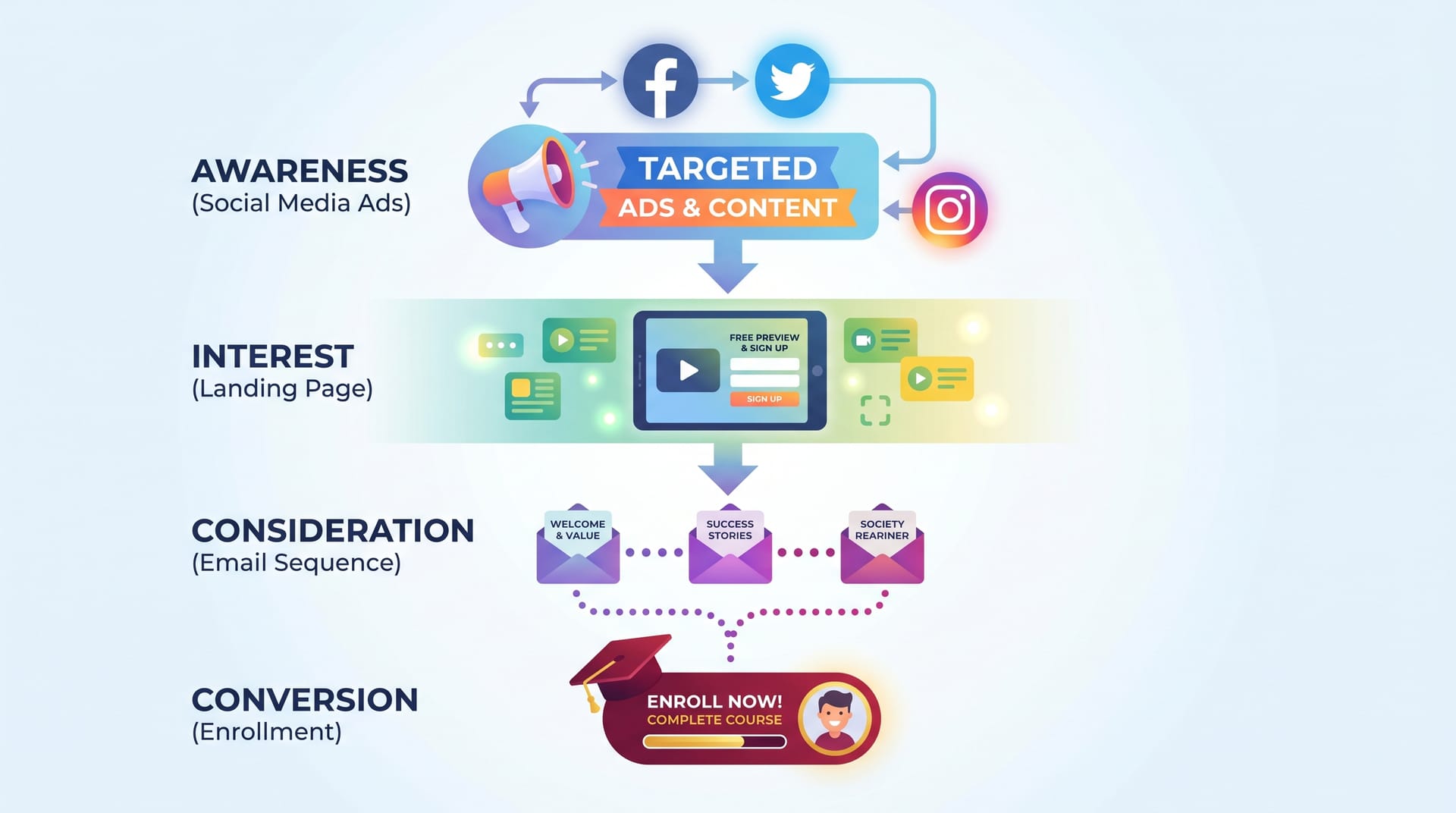
The AIDA funnel for course creators:
| Stage | Goal | Tactics | Key Metric |
|---|---|---|---|
| Awareness | Attract strangers | SEO blog posts, YouTube videos, social content, podcast guesting | Traffic volume |
| Interest | Capture contact info | Lead magnets, waitlists, free mini-courses, webinars | Opt-in rate |
| Decision | Build desire and trust | Email nurture sequences, case studies, testimonials, FAQ content | Email open/click rate |
| Action | Convert to sale | Sales page, checkout flow, urgency, guarantees, payment plans | Conversion rate |
Funnel optimization tactics:
- Audit your drop-off points. If 1,000 people visit your landing page and 10 buy, your conversion rate is 1%. Test headlines, testimonials, and CTAs to push it to 2%. That doubles revenue without more traffic.
- Speed up your pages. A one-second delay in page load time can reduce conversions by 7%. Compress images, remove unnecessary scripts, and use a fast host.
- Simplify your checkout. Every extra form field kills sales. Name, email, and payment info. That is it.
- Add exit-intent popups. When someone moves to close the tab, offer a lead magnet or a final discount. It recovers 3�C5% of abandoning visitors.
Case Studies: Successful Course Launches
Theory is useful. Results are better. Here are two real-world examples of course creators who used these online course marketing ideas to generate six-figure launches.
Case Study 1: The Design Educator Who Pre-Sold Before Recording
Background: Maya Chen had 12,000 Instagram followers but zero email list. She wanted to launch a $497 course on freelance graphic design.
Strategy:
- Maya announced a waitlist with a simple landing page 90 days before her intended launch. She promoted it through Instagram Stories, Reels, and a pinned post.
- She ran a free 5-day email challenge called “Land Your First $1,000 Client.” The challenge delivered one actionable lesson per day and ended with an invitation to join her course.
- She recruited 10 beta testers from her waitlist at $97 each. They provided testimonials and case studies she used in her launch emails.
- During launch week, she hosted a live webinar with a 24-hour fast-action bonus. Her email sequence included daily value-driven emails with clear deadlines.
Results: Maya sold 312 seats in her first launch, generating $155,064 in revenue. Her email list grew from 0 to 4,200 subscribers. Today, the course runs on an evergreen webinar funnel that generates $8,000�C$12,000 per month with minimal maintenance.
Key takeaway: Pre-selling validates demand, funds production, and creates urgency. Do not build in secret.
Case Study 2: The Developer Who Used Content and Affiliates to Scale
Background: James Okoro was a software developer with a small YouTube channel (8,000 subscribers) teaching React. He launched a $299 course on advanced React patterns.
Strategy:
- James published one YouTube tutorial per week for 6 months before launch. Each video targeted a specific search query like “React performance optimization” or “custom hooks tutorial.”
- He created a free “React Cheatsheet” as a lead magnet and promoted it in every video description. This grew his email list to 6,500 subscribers.
- He reached out to 15 React-focused newsletters and podcasts, offering 40% affiliate commissions. Five agreed to promote his launch.
- He designed professional landing pages and ad creatives using NeoSpark, ensuring his visual presence matched the quality of his teaching.
- His launch included a 72-hour early bird price of $199, followed by the regular price.
Results: James sold 580 seats, generating $134,820 in launch revenue. Affiliate partners drove 42% of total sales. His YouTube channel now serves as a perpetual lead generator, adding 200�C300 email subscribers per month.
Key takeaway: Content builds trust over time. Affiliates multiply reach instantly. Combine both for maximum impact.
Frequently Asked Questions
How early should I start marketing my online course?
Start at least 60�C90 days before you plan to open enrollment. Use this time to build a waitlist, publish content, and validate demand. The creators who struggle are the ones who announce a course the week it is ready.
Do I need a large audience to launch a successful course?
No. A small, engaged audience beats a large, passive one every time. You can launch successfully with 500�C1,000 email subscribers if they are the right people. Focus on depth of relationship, not breadth of reach.
What is the best platform for selling online courses?
The best platform depends on your needs. Teachable and Thinkific are excellent for beginners. Kajabi offers all-in-one marketing tools. Circle and Mighty Networks work well for community-driven courses. Choose based on your budget, technical comfort, and whether you need built-in email marketing.
How much should I spend on ads for my course launch?
Start with $0. Validate your offer organically first. Once you have a converting sales page and a proven webinar or funnel, reinvest 20�C30% of revenue into paid traffic. Scaling ads before you have product-market fit is the fastest way to burn money.
Should I offer a money-back guarantee?
Yes. A 30-day guarantee reduces perceived risk and typically increases conversions by 15�C25%. The refund rate for quality courses is usually 3�C8%. The extra sales far outweigh the refunds.
How do I price my online course?
Price based on the transformation, not the length. A course that helps someone land a $80,000 job can command $1,000+. A hobby course might sell for $97�C$297. Test pricing with your waitlist through surveys: “Would you pay $X for this outcome?”
Can I use AI tools to create my course marketing materials?
Absolutely. AI tools like NeoSpark help you generate landing pages, social graphics, ad creatives, and email copy in minutes instead of hours. The key is to use AI for speed and iteration, then add your unique voice and expertise before publishing.
Conclusion
Marketing an online course is not about finding a single magic tactic. It is about building a system that attracts, nurtures, and converts the right people consistently.
Here are the six key takeaways to implement today:
- Validate before you build. Use a waitlist and pre-sales to prove demand before you record a single lesson.
- Own your audience. An email list is the only marketing asset you truly control. Start growing it now.
- Launch with urgency. Deadlines, bonuses, and scarcity create the momentum needed for a profitable launch.
- Go evergreen. Turn your live launch into an automated funnel that generates sales while you focus on teaching.
- Invest in visuals. Professional design signals professional quality. Your landing pages and ads are your first impression.
- Optimize relentlessly. Small improvements at each funnel stage compound into massive revenue gains over time.
The creators who treat their course as a business��not a side project��are the ones who build sustainable, profitable education empires. Pick one strategy from this guide, execute it this week, and build from there.
Related Resources
- How to Design High-Converting Course Landing Pages with NeoSpark
- The Complete Guide to AI-Powered Marketing Assets
- NeoSpark Social Media Graphics Templates for Course Creators
- Email Funnel Blueprint: From First Click to First Sale
- NeoSpark Visual Editor: Create Ads, Thumbnails, and Course Covers in Minutes
- Webinar Slide Deck Templates by NeoSpark
Ready to turn your course into a best-seller? Start designing your marketing assets with NeoSpark today.