Wedding Pictures: The Ultimate Guide to Stunning Shots in 2026 (+ AI Alternatives)
Wedding Pictures: The Ultimate Guide to Stunning Shots in 2026 (+ AI Alternatives)
Published: March 20, 2026 | Reading Time: 15 min | Level: Beginner to Intermediate
TL;DR: Great wedding pictures require planning, the right style, and a clear shot list. But in 2026, you don't need a $5,000 photographer to get magazine-worthy wedding portraits—AI tools like NeoSpark generate stunning, hyper-realistic wedding photos from a single selfie in minutes.
Table of Contents
- Why Wedding Pictures Matter More Than Any Other Photo
- Top 7 Wedding Photography Styles
- The 30 Must-Have Wedding Shots (Checklist)
- How to Take Perfect Wedding Pictures: 8 Pro Tips
- Editing Wedding Pictures: What to Expect
- AI-Generated Wedding Pictures: The 2026 Revolution
- NeoSpark vs. Hiring a Photographer: Honest Comparison
- FAQ
- Conclusion
Why Wedding Pictures Matter More Than Any Other Photo {#why-they-matter}
Your wedding day lasts one day. Your wedding pictures last a lifetime.
Unlike birthday photos or vacation snapshots, wedding pictures carry a different emotional weight. They’re the images you’ll frame on your wall, share with your children, and look back on in 50 years. According to a 2025 wedding industry survey, 89% of married couples ranked photography as the single most important vendor investment—above flowers, catering, and even the venue.
Yet an astonishing number of couples end up disappointed with their wedding photos. The reasons are almost always the same:
- No clear shot list communicated to the photographer
- Wrong photography style for the venue and lighting
- Post-editing that doesn’t match the couple’s aesthetic
- Budget constraints forcing a compromise on quality
This guide solves all four problems—and introduces a game-changing alternative for couples who want luxury wedding portraits without the luxury price tag.
Top 7 Wedding Photography Styles {#photography-styles}
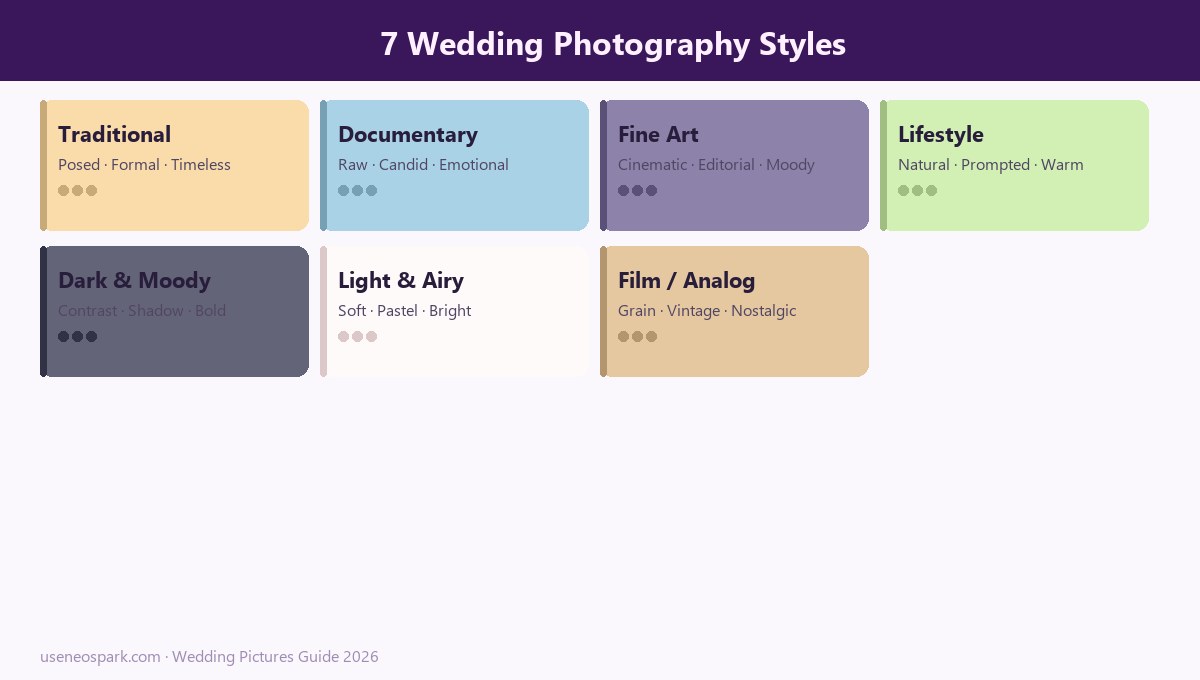
The biggest mistake couples make when planning their wedding pictures? Not aligning on a photography style before booking anyone. Here are the seven most popular styles in 2026:
1. Traditional / Classic
The gold standard for formal weddings. Expect posed portraits, clean compositions, and timeless editing. Every family member gets their moment. Best for: church weddings, ballroom receptions, formal black-tie events.
2. Photojournalistic / Documentary
The photographer blends into the background and captures raw, unposed emotion—tears, laughter, chaotic first dances. Zero posing, maximum authenticity. Best for: couples who hate being in front of a camera.
3. Fine Art
Heavily curated, cinematic frames inspired by editorial fashion photography. Think moody shadows, dramatic landscapes, and artistic compositions. Best for: outdoor venues, destination weddings, fashion-forward couples.
4. Lifestyle / Candid
A hybrid between documentary and traditional. The photographer gives loose prompts (“walk together toward the sunset”) and captures natural-feeling moments. Best for: couples who want genuine emotion without complete chaos.
5. Dark & Moody
Deep contrast, desaturated greens, shadow-heavy editing. Hugely popular on Instagram and Pinterest. Best for: forest venues, winter weddings, gothic or industrial spaces.
6. Light & Airy
Soft whites, pastel tones, overexposed highlights. The opposite of dark and moody. Best for: beach weddings, garden ceremonies, bright churches.
7. Film / Analog
Shot on real 35mm or medium-format film—or digitally edited to mimic grain, faded colors, and light leaks. Gives wedding pictures an irreplaceable vintage quality. Best for: couples who love nostalgia and tactile aesthetics.
The 30 Must-Have Wedding Shots (Checklist) {#must-have-shots}
Print this list and give it to your photographer before the wedding day.
Getting Ready (Before the Ceremony)
- Detail shots: dress hanging, rings, shoes, bouquet
- Bride getting makeup done
- Groom and groomsmen getting ready (candid)
- First look reaction (if applicable)
- Full-length portrait of the bride alone
- Full-length portrait of the groom alone
The Ceremony
- Processional walk down the aisle
- Officiant and couple at the altar
- Ring exchange close-up
- The kiss
- Guests’ reactions during vows
- Recessional (couple walking back up the aisle together)
Family Formals
- Bride + her parents
- Groom + his parents
- Both families together
- Wedding party group photo
- Bridesmaids together
- Groomsmen together
Couple Portraits (Golden Hour)
- Classic portrait facing camera
- Walking together from behind
- Laughing candid
- Dip/dance pose
- Silhouette against the sky
- Intimate forehead touch
Reception
- First dance
- Father-daughter / mother-son dance
- Cake cutting
- Bouquet toss
- Guests on the dance floor
- Couple sneaking away for a quiet moment
| Shot Category | Min. # of Shots | Priority |
|---|---|---|
| Getting Ready | 20–30 | ⭐⭐⭐ |
| Ceremony | 50–80 | ⭐⭐⭐⭐⭐ |
| Family Formals | 20–40 | ⭐⭐⭐⭐ |
| Couple Portraits | 30–50 | ⭐⭐⭐⭐⭐ |
| Reception | 60–100 | ⭐⭐⭐⭐ |
How to Take Perfect Wedding Pictures: 8 Pro Tips {#pro-tips}
Whether you’re working with a professional photographer or exploring DIY options, these tips apply universally.
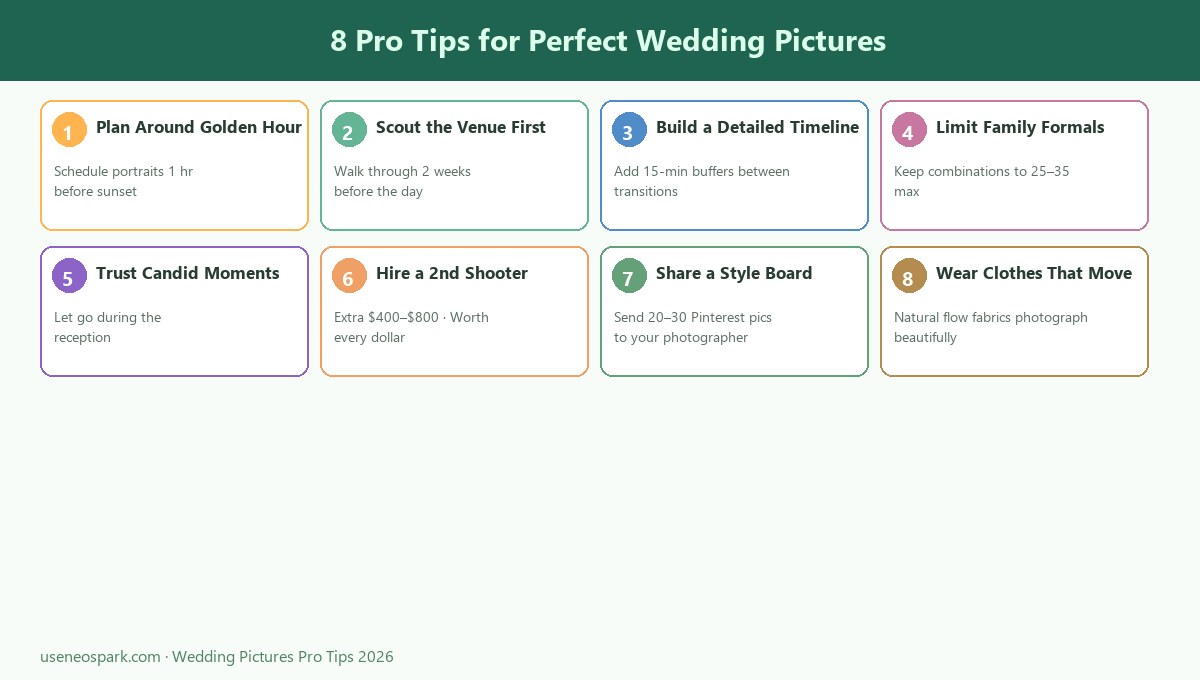
1. Plan Around Golden Hour
The hour after sunrise and the hour before sunset produce the most flattering, cinematic light possible. Schedule your couple portraits during this window—every wedding photographer will thank you.
2. Scout the Venue Beforehand
Walk through the ceremony and reception spaces with your photographer at least 2 weeks before the wedding. Identify the best backdrops, natural light sources, and spots to avoid (ugly fire exits, busy parking lots).
3. Create a Detailed Timeline
Rushed timelines kill good wedding pictures. Build in 15-minute buffers between every transition. Give yourself at least 45 minutes for couple portraits during golden hour.
4. Keep the Shot List to 25–35 Family Combinations
Family formal sessions are the biggest time sink at weddings. Be ruthless—only include the combinations you’ll actually print and frame.
5. Trust the Candid Moments
Posed photos are predictable. The photos you’ll cry over 20 years from now are the ones where you forgot the camera was there. Remind yourself: let go of control during the reception.
6. Invest in a Second Shooter
A second photographer costs an extra $400–$800 but captures angles and moments the lead photographer physically can’t be in two places to get. For the ceremony especially, it’s worth every dollar.
7. Communicate Your Style Board
Before the wedding, build a Pinterest board with 20–30 wedding pictures you love. Send it to your photographer. Style is hard to describe in words—images communicate it perfectly.
8. Wear Clothes That Move Well
For portraits, avoid stiff fabrics that don’t flow. Dresses and suits that move naturally in the wind photograph beautifully. Ask your stylist specifically about this.
Editing Wedding Pictures: What to Expect {#editing}
Raw photos from even the best wedding photographers don’t look like what ends up in your gallery. Editing is where the magic happens—and knowing what to expect prevents disappointment.
The Standard Editing Workflow
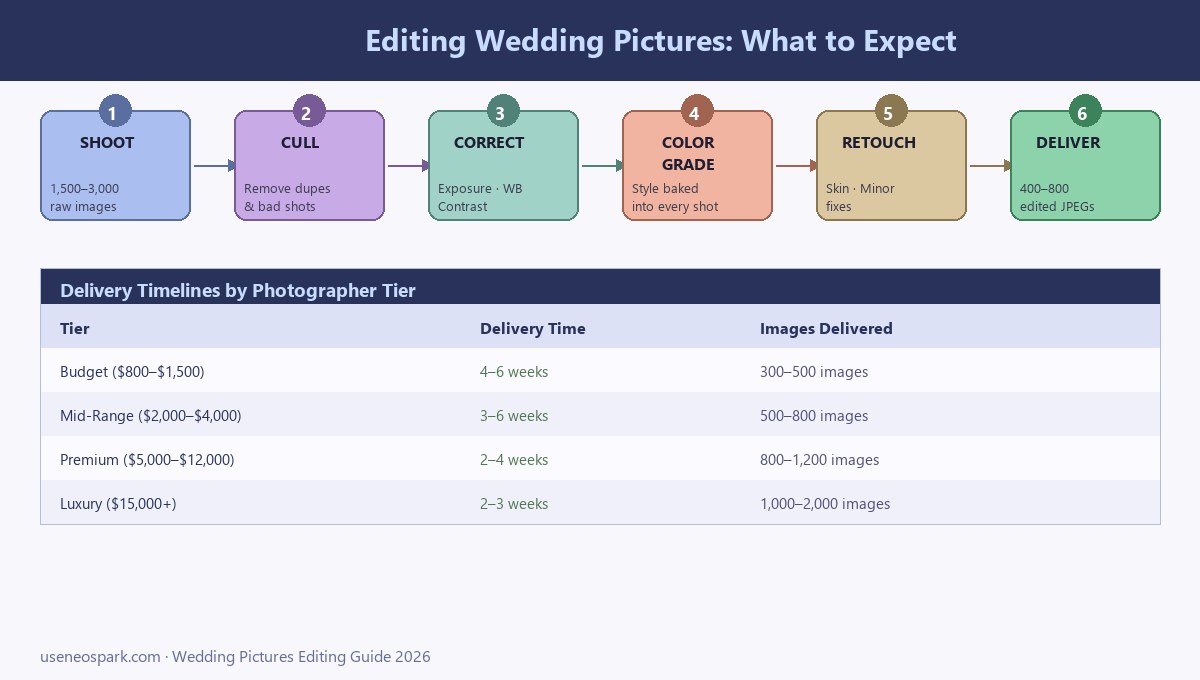
Culling — A professional photographer shoots 1,500–3,000 images in a full day and delivers 400–800 edited final images. Culling removes duplicates, out-of-focus frames, and unflattering expressions.
Basic Corrections — Every delivered image gets exposure, white balance, contrast, and shadow corrections applied. This is the baseline.
Color Grading — This is where the photographer’s unique style gets baked in. A light-and-airy photographer will lift shadows and reduce saturation. A dark-and-moody photographer will crush blacks and shift greens toward teal. You’re essentially paying for this aesthetic.
Retouching — Most photographers include light skin retouching (blemishes, minor under-eye circles) on portraits. Heavy retouching—body reshaping, background replacements—typically costs extra.
Typical Delivery Timelines
| Photographer Tier | Delivery Time | Edited Images Delivered |
|---|---|---|
| Budget ($800–$1,500) | 4–6 weeks | 300–500 |
| Mid-Range ($2,000–$4,000) | 3–6 weeks | 500–800 |
| Premium ($5,000–$12,000) | 2–4 weeks | 800–1,200 |
| Luxury ($15,000+) | 2–3 weeks | 1,000–2,000 |
One thing nobody tells couples: the editing style you see in a photographer’s portfolio is what you’ll get delivered. If you want a different look, you’d need to renegotiate or pay extra. Always choose a photographer whose editing style you already love—don’t assume they’ll change it for you.
AI-Generated Wedding Pictures: The 2026 Revolution {#ai-wedding-pictures}
Here’s a question most wedding blogs won’t ask: What if you could get luxury wedding portraits without a photographer at all?
In 2026, AI image generation has crossed a threshold where the results are indistinguishable from professional wedding photography—for a fraction of the cost.
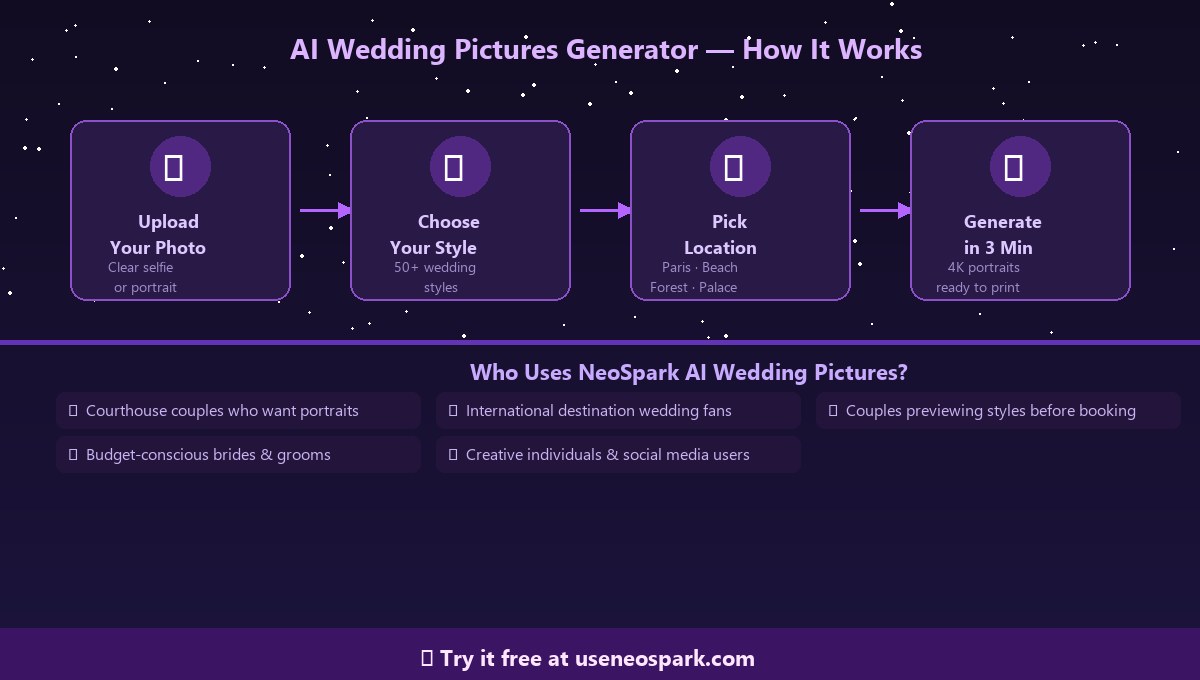
How AI Wedding Picture Generation Works
- Upload your photo — A clear selfie or portrait photo of yourself (or as a couple)
- Choose a wedding style — Classic white gown, cultural traditional, modern minimalist, fantasy garden, and dozens more
- Select a scene — Cathedral interior, beach sunset, vineyard, snowy mountains, Parisian street
- Generate — In under 3 minutes, receive 4–8 unique, high-resolution wedding portraits
The AI doesn’t just put your face on a generic model—it recreates your actual features, skin tone, hair, and expressions in a photorealistic wedding scenario.
Who’s Actually Using This?
- Couples who got married at the courthouse and want beautiful portraits without the cost of a full ceremony reshoot
- International couples who want destination wedding photos from Paris, Tuscany, or Japan without traveling
- Engaged couples who want to preview how they’ll look in different wedding styles before booking
- Budget-conscious couples who want to allocate more of their wedding budget to the honeymoon
- Solo individuals who want to create AI wedding portraits for fun, social media, or creative projects
NeoSpark vs. Hiring a Photographer: Honest Comparison {#comparison}
We’re not going to pretend AI is a perfect replacement for every use case. Here’s an honest breakdown:
| Factor | Traditional Photographer | NeoSpark AI |
|---|---|---|
| Cost | $2,000–$12,000 | From $9 |
| Turnaround | 2–8 weeks | Under 3 minutes |
| Location flexibility | Limited to real venues | Any location imaginable |
| Style variety | 1 photographer style | 50+ styles per session |
| Requires scheduling | Yes (months in advance) | No — instant anytime |
| Documents your actual day | Yes ✓ | No (AI-generated) |
| Both people in photo | Yes ✓ | Solo portraits (couples coming soon) |
| Best use case | Documenting the real wedding day | Portraits, previews, reshoots, fun |
Our verdict: Traditional photography and AI wedding pictures serve different purposes. If you’re getting married, hire a photographer to document your actual day. But use NeoSpark for everything else—portrait experimentation, alternative styles you couldn’t afford in real life, or creating the stunning destination wedding pictures you never got to take.
FAQ {#faq}
Q: How many wedding pictures should I expect from a photographer? A: For a full 8-hour wedding day with one photographer, expect 400–600 edited images. With a second shooter, 600–900. Budget photographers typically deliver fewer; luxury photographers typically deliver more and spend longer on editing.
Q: How long until I get my wedding pictures back? A: Industry standard is 4–6 weeks. Some busy photographers during peak season (May–October) take up to 8 weeks. Get the delivery timeframe in writing in your contract.
Q: Can I edit my own wedding pictures after delivery? A: Yes, but check your contract first. Some photographers prohibit filters or heavy edits that alter their style. Light adjustments (brightness, crop) are almost always fine.
Q: What’s the best format to receive wedding pictures in? A: Always ask for full-resolution JPEGs (minimum 3,000px on the long edge). This ensures you can print large without quality loss. Some photographers also deliver RAW files—useful if you plan to edit yourself.
Q: Are AI-generated wedding pictures legal to use on social media? A: Yes. Images generated by AI on platforms like NeoSpark are owned by the user and can be posted, printed, and shared freely. Always check the platform’s specific terms of service.
Q: How realistic do AI wedding pictures look? A: In 2026, the best AI models produce images that are indistinguishable from professional photography at normal viewing distances. NeoSpark uses the latest generation of photorealistic AI to preserve your actual facial features in the generated portraits.
Q: Can I print AI wedding pictures? A: Absolutely. NeoSpark delivers high-resolution outputs (up to 4K) that print beautifully at standard photo sizes (4×6, 8×10, 16×20, canvas prints).
Q: What wedding picture ideas work best with AI generation? A: Destination scenes (Paris, Santorini, cherry blossom Japan), fantasy settings (enchanted forest, twilight beach), and high-fashion editorial styles tend to produce the most dramatic and shareable results.
Conclusion {#conclusion}
Wedding pictures are irreplaceable—whether they’re shot on your actual wedding day or generated by AI for the dream portraits you never got to take.
The most important things to remember:
- Choose a photography style before you choose a photographer
- Share a shot list and timeline before the wedding day
- Understand that editing takes time—be patient with your photographer
- Consider AI wedding pictures for portraits, reshoots, or any scenario where traditional photography isn’t practical
And if you want to see yourself in a wedding dress (or suit) in any location in the world—without booking a photographer, renting a venue, or waiting weeks for edits—NeoSpark can make it happen in three minutes.
See Yourself in a Wedding Portrait — in 3 Minutes
Upload one photo. Choose your style. Get stunning wedding pictures.
Used by thousands of couples, individuals, and creatives worldwide.
✨ Try NeoSpark Free — Create Your Wedding Pictures NowNo credit card required for your first generation · Results in under 3 minutes
Share this guide: