Image Generation API: A Developer's Guide to AI Image Generation Capabilities in 2026
Alex Zhang is the founder of NeoSpark, an AI-powered design platform helping creators and teams generate images, videos, and brand assets without design skills.
Image Generation API: A Developer’s Guide to AI Image Generation Capabilities in 2026
Need to add AI image generation to your app? This guide covers everything developers need to know about image generation APIs, 2026 capabilities, and whether Grok XAI image generation is free or paid.
Published: July 5, 2026 | Updated: July 5, 2026 Reading Time: 14 minutes Audience: Developers, Product Managers, CTOs
TL;DR
An image generation API lets your application create AI-powered images programmatically. In 2026, the best APIs offer text-to-image, image-to-image editing, inpainting, style transfer, and batch generation at costs ranging from $0.002 to $0.08 per image.
| Use Case | Best API Choice | Why |
|---|---|---|
| Ease of integration | OpenAI DALL-E 3 API | Simple REST endpoints, excellent prompt adherence |
| Artistic quality | Midjourney API | Best-in-class stylized outputs |
| Customization | Stability AI API | Open weights, fine-tuning, local options |
| Commercial/Business | NeoSpark API | Brand consistency, commercial-ready licensing |
| Photorealism | Grok Imagine / xAI | Fast, realistic renders, X integration |
On Grok XAI image generation free or paid current status: As of July 2026, Grok Imagine offers limited free access through X Premium and periodic free credits, but sustained use requires paid credits. Terms vary by region.
What Is an Image Generation API?
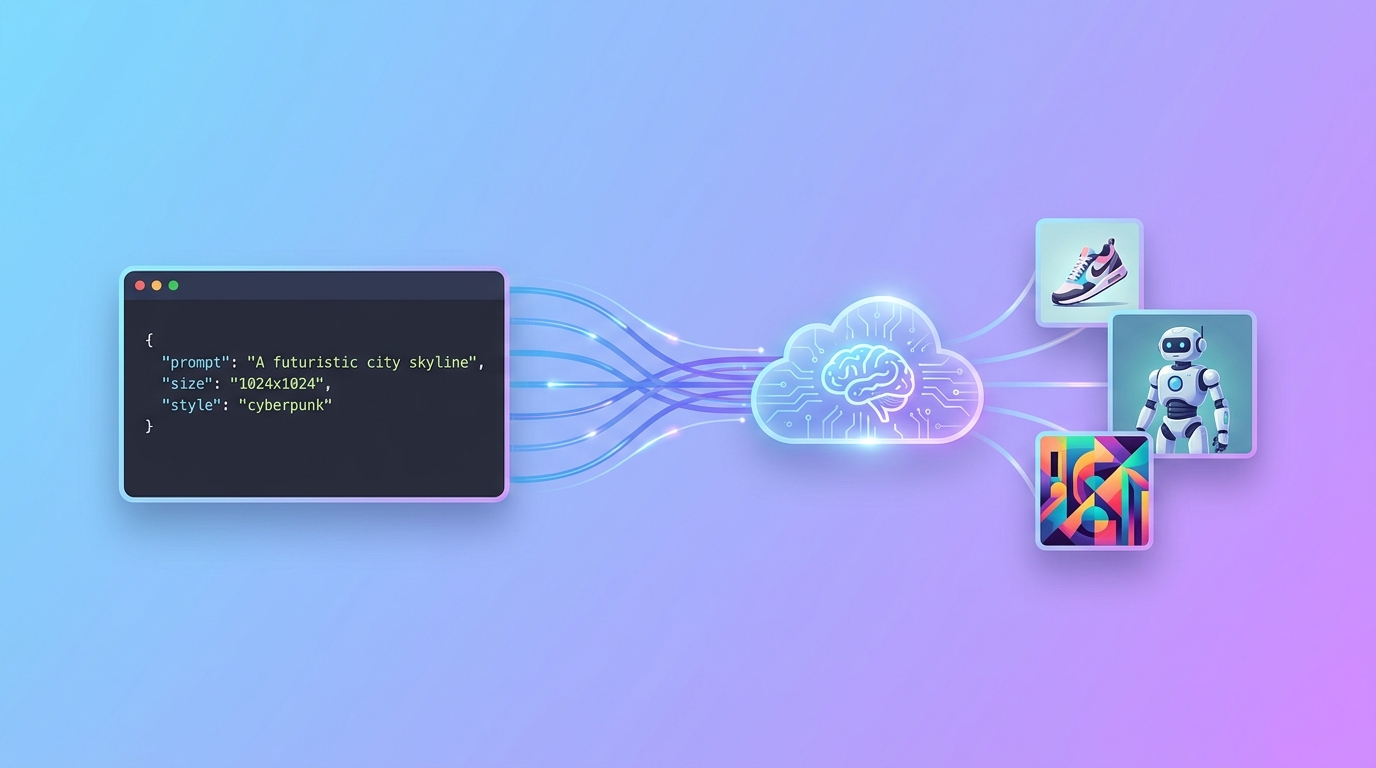
An image generation API is a cloud-based programming interface that converts text descriptions, existing images, or structured inputs into AI-generated images. Instead of running large diffusion models on your own servers, you send a request to a provider’s API and receive an image URL or base64-encoded image in response.
Core Components
| Component | Description |
|---|---|
| Endpoint | The URL your application calls (e.g., /v1/images/generations) |
| Prompt | Text description of the desired image |
| Parameters | Size, aspect ratio, style, number of outputs, seed |
| Model | The underlying AI model (DALL-E 3, Stable Diffusion, Flux, etc.) |
| Authentication | API key or OAuth token |
| Response | Image URL(s), base64 data, generation metadata |
Why Use an API Instead of Self-Hosting?
- No GPU infrastructure required
- Faster time to market with simple HTTP calls
- Automatic model updates from providers
- Scalable without managing inference clusters
- Compliance handled by the platform
AI Image Generation Capabilities 2026
The AI image generation capabilities 2026 landscape has expanded far beyond simple text-to-image. Here’s what developers should know about the current state of image generation APIs. Here are the features modern developers should expect:
1. Text-to-Image Generation
The foundational capability: describe an image in natural language, receive a matching output. In 2026, leading models understand:
- Complex spatial relationships
- Multiple subjects and actions
- Artistic styles and camera terminology
- Text rendering (improved but still model-dependent)
2. Image-to-Image Editing
Upload an existing image and modify it with a text prompt. Common operations include:
- Style transfer
- Background replacement
- Object addition or removal
- Lighting and color adjustments
3. Inpainting and Outpainting
| Technique | What It Does | Common Use Case |
|---|---|---|
| Inpainting | Fills masked regions of an image | Remove objects, fix artifacts |
| Outpainting | Extends an image beyond its borders | Convert portrait to landscape, add context |
4. Upscaling and Resolution Enhancement
Most APIs now support:
- 1024×1024 standard outputs
- 2K and 4K upscaling
- Detail enhancement without re-generation
5. Style and Brand Consistency
Business-focused APIs like NeoSpark provide:
- Style presets for photography, illustration, product shots
- Character consistency across generations
- Brand color locking
- Batch generation with uniform style
6. Batch and Async Generation
For high-volume applications, APIs support:
- Bulk prompt submissions
- Webhook callbacks when generations complete
- Queue management for large workloads
7. Safety and Moderation
Enterprise APIs include:
- Content policy enforcement
- NSFW filtering
- Bias mitigation
- Audit logs for compliance
How Image Generation APIs Work
Understanding the request flow helps you build reliable integrations.
Typical API Request Flow
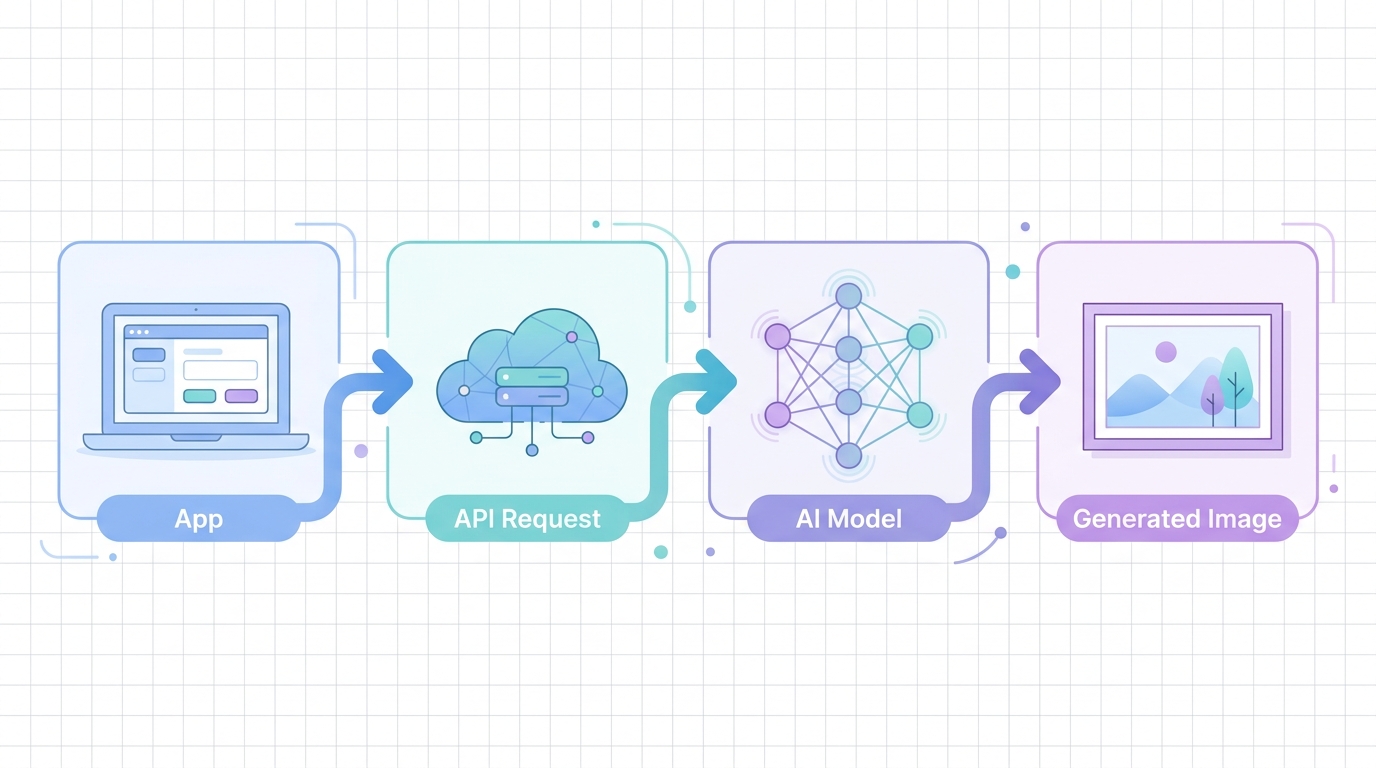
Your App → HTTP Request → API Gateway → AI Model → Generated Image → Response
A Basic Text-to-Image Request
Most APIs accept a JSON payload like this:
{
  "model": "dall-e-3",
  "prompt": "A minimalist product photo of a white wireless headphone on a marble surface, soft studio lighting, 8k, commercial photography",
  "size": "1024x1024",
  "quality": "standard",
  "n": 1
}
Response Format
{
  "created": 1712345678,
  "data": [
    {
      "url": "https://api.example.com/images/generated_123.png",
      "revised_prompt": "A minimalist product photo..."
    }
  ]
}
Latency Considerations
| Generation Type | Typical Latency | Best Practice |
|---|---|---|
| Standard text-to-image | 3–10 seconds | Use async endpoints for batches |
| High-resolution | 10–30 seconds | Implement polling or webhooks |
| Image-to-image | 5–15 seconds | Cache reference images |
| Batch generation | 30–120 seconds | Queue and process asynchronously |
Top Image Generation APIs Compared
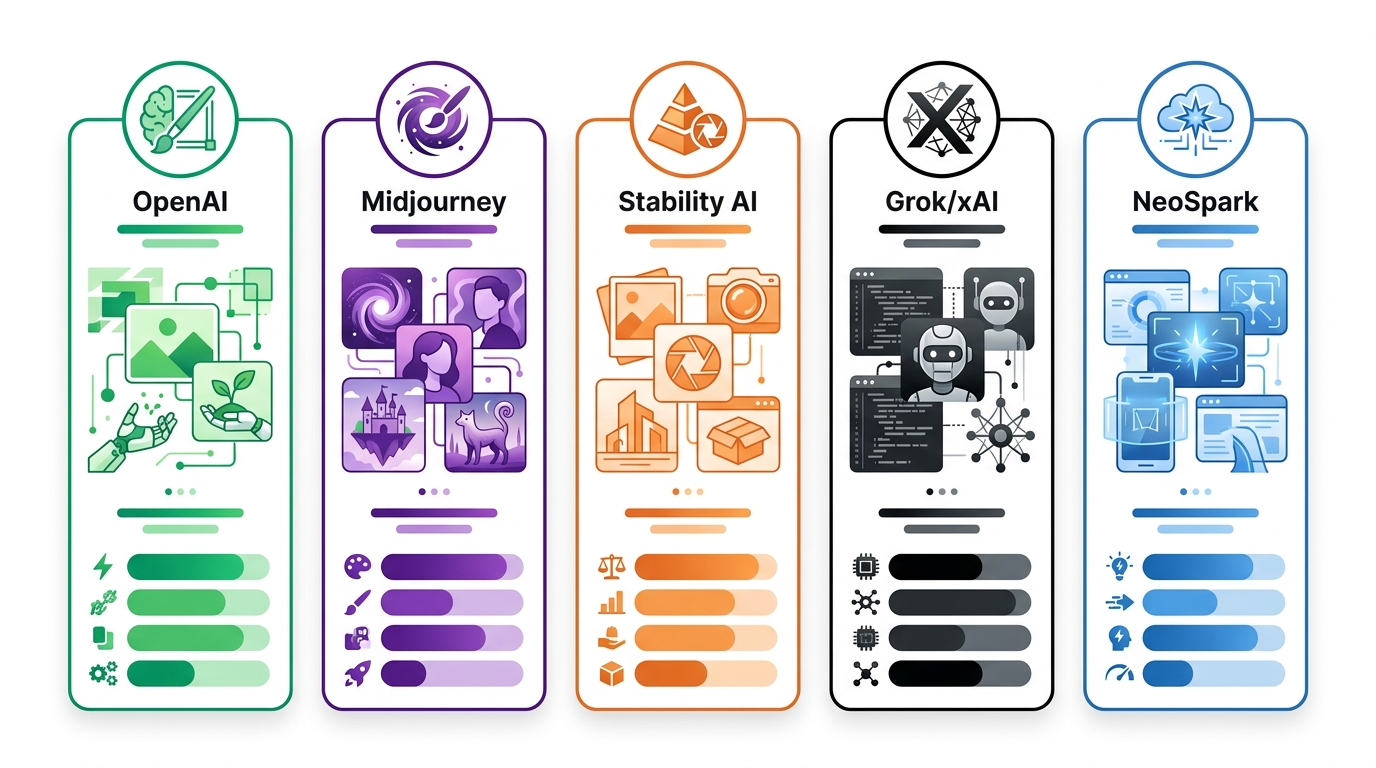
| Provider | Best For | Pricing Model | Strengths | Limitations |
|---|---|---|---|---|
| OpenAI DALL-E 3 | Ease of use, prompt accuracy | Per-image ($0.04–$0.08) | Excellent prompt adherence, simple API | Less customizable, moderate artistic style |
| Midjourney API | Artistic quality | Subscription + GPU time | Stunning artistic outputs, strong community | More complex integration, async-only |
| Stability AI API | Customization, open models | Per-credit ($0.002–$0.02) | Open weights, fine-tuning, cost-effective | Requires more tuning for best results |
| Black Forest Labs (Flux) | Open-source quality | API credits or self-hosted | High quality, flexible licensing | Newer ecosystem |
| Grok Imagine / xAI | Photorealism, X integration | Credits / X Premium | Very fast, photorealistic, meme-friendly | Terms vary, less enterprise-focused |
| NeoSpark API | Commercial use, brand consistency | Tiered plans | Business licensing, style locking, batch workflows | Smaller ecosystem than OpenAI |
Comparison Matrix: Core Capabilities
| Capability | DALL-E 3 | Midjourney | Stability AI | Grok Imagine | NeoSpark |
|---|---|---|---|---|---|
| Text-to-image | ✅ | ✅ | ✅ | ✅ | ✅ |
| Image-to-image | ✅ | ⚠️ Limited | ✅ | ✅ | ✅ |
| Inpainting | ✅ | ❌ | ✅ | ⚠️ | ✅ |
| Upscaling | ✅ | ✅ | ✅ | ⚠️ | ✅ |
| Batch generation | ✅ | ⚠️ | ✅ | ⚠️ | ✅ |
| Custom fine-tuning | ❌ | ❌ | ✅ | ❌ | ✅ |
| Commercial license | ✅ Paid | ✅ Paid | ✅ Paid | ⚠️ Varies | ✅ All plans |
Grok XAI Image Generation Free or Paid Current Status
The most common question we see about xAI’s image tool is straightforward: grok xai image generation free or paid current status? Here’s the answer as of July 2026.
How Grok Imagine Access Works
Grok Imagine is xAI’s image generation model, integrated into the Grok AI assistant across X (formerly Twitter) and the standalone Grok interface.
| Access Method | Free? | Notes |
|---|---|---|
| X Premium subscription | Partially | Includes some image generations per month |
| X Premium+ subscription | More generous | Higher generation limits |
| Standalone credit packs | Paid | Purchase credits for additional generations |
| Periodic promotions | Limited free credits | Free trials or bonus credits |
What We Know About Grok Imagine Pricing
- Grok Imagine is not entirely free for heavy use.
- X Premium subscribers receive a bundled allowance of image generations.
- Additional generations beyond the bundled allowance require purchasing credits.
- Pricing and allowance structures have changed multiple times since launch.
⚠️ Important: xAI updates Grok Imagine’s pricing and access tiers frequently. Always verify the current terms directly on x.ai or the X platform before building a production workflow around it.
Grok Imagine Strengths
- Speed: Often generates images in under 3 seconds
- Photorealism: Strong performance on realistic scenes
- Meme and social content: Excels at internet-culture visuals
- X integration: Direct sharing to timelines
When to Choose Grok Imagine vs. an API
| Scenario | Recommendation |
|---|---|
| Building an app that needs reliable image generation | Use a dedicated image generation API like DALL-E 3 or NeoSpark |
| Creating social media content quickly | Grok Imagine via X can be convenient |
| Need enterprise SLA and support | Choose OpenAI, Stability AI, or NeoSpark |
| Want open-source control | Use Stability AI or Flux models |
How to Choose the Right Image Generation API
Decision Framework
What matters most?
│
├─→ Ease of integration and reliability
│   └─→ OpenAI DALL-E 3 API
│
├─→ Best artistic quality
│   └─→ Midjourney API
│
├─→ Lowest cost and maximum customization
│   └─→ Stability AI API or self-hosted Flux
│
├─→ Commercial safety and brand consistency
│   └─→ NeoSpark API
│
└─→ Fast photorealistic content for social
    └─→ Grok Imagine (with paid credits)
Evaluation Checklist
- Pricing transparency: Per-image cost, overage rates, free tier
- Commercial rights: Can outputs be used for business?
- Uptime and SLA: What’s the guaranteed availability?
- Latency: Synchronous vs. async options
- Model variety: Can you choose different models for different tasks?
- Safety controls: Content filtering, moderation
- Support: Documentation, SDKs, community
Getting Started: Image Generation API Code Example
Here’s a simple example of calling an image generation API from a Node.js application.
const response = await fetch('https://api.provider.com/v1/images/generations', {
  method: 'POST',
  headers: {
    'Authorization': `Bearer ${process.env.IMAGE_API_KEY}`,
    'Content-Type': 'application/json',
  },
  body: JSON.stringify({
    model: 'text-to-image-v1',
    prompt: 'A modern SaaS dashboard mockup on a laptop screen, clean minimal design, soft gradient background, professional product photography',
    size: '1024x1024',
    n: 1,
  }),
});

const data = await response.json();
const imageUrl = data.data[0].url;
Python Example
import requests

response = requests.post(
    'https://api.provider.com/v1/images/generations',
    headers={'Authorization': f'Bearer {API_KEY}'},
    json={
        'model': 'text-to-image-v1',
        'prompt': 'A hand holding a smartphone displaying a fitness app, outdoor morning light, lifestyle photography',
        'size': '1024x1024',
        'n': 1,
    }
)

image_url = response.json()['data'][0]['url']
Best Practices for API Integration
- Use environment variables for API keys
- Implement retries with exponential backoff
- Cache generated images to reduce costs
- Validate prompts before sending to avoid policy violations
- Store generation metadata for audit and reproducibility
Image Generation API Pricing Comparison (2026)
| Provider | Free Tier | Standard Cost | Notes |
|---|---|---|---|
| OpenAI DALL-E 3 | Limited credits | $0.04–$0.08/image | Simple, predictable pricing |
| Midjourney API | No free API tier | ~$10/month + usage | Subscription-based |
| Stability AI | Trial credits | $0.002–$0.02/image | Very cost-effective at scale |
| Flux / Black Forest Labs | Varies by host | $0.01–$0.04/image | Competitive quality |
| Grok Imagine | Limited via X Premium | Credit packs | Pricing varies by region |
| NeoSpark | 50 generations/day free | Tiered plans | Commercial rights included |
Cost Optimization Tips
- Start with lower resolution for drafts, upscale only finalists
- Use batch endpoints to reduce per-request overhead
- Implement caching so repeated prompts don’t trigger new charges
- Choose the right model for the task—artistic prompts don’t need the most expensive photorealistic model
Use Cases for Image Generation APIs
E-Commerce
Generate product lifestyle photos, model shots, and packaging mockups without photoshoots.
Marketing and Advertising
Create campaign visuals, social media assets, and ad creatives at scale.
Publishing and Media
Produce article featured images, book covers, and thumbnail graphics.
Gaming and Entertainment
Generate concept art, character designs, textures, and promotional artwork.
SaaS and Apps
Add AI image generation as a feature inside your application for end users.
FAQ
Q: What is an image generation API?
A: An image generation API is a cloud service that lets applications create images using AI models through HTTP requests. You send a prompt or reference image, and the API returns a generated image.
Q: What are the main AI image generation capabilities in 2026?
A: In 2026, leading APIs support text-to-image, image-to-image editing, inpainting, outpainting, upscaling, style transfer, batch generation, and brand consistency controls.
Q: Is Grok XAI image generation free or paid in 2026?
A: As of July 2026, Grok Imagine is partially free for X Premium subscribers with bundled credits, but heavy or commercial use typically requires purchasing credit packs. Pricing and allowances change frequently, so check xAI’s current terms.
Q: Which image generation API is best for beginners?
A: OpenAI’s DALL-E 3 API is the easiest to start with due to clear documentation, reliable responses, and strong prompt adherence.
Q: Can I use image generation API outputs commercially?
A: Most paid APIs allow commercial use, but terms vary. OpenAI DALL-E, Stability AI, and NeoSpark generally permit commercial use on paid tiers. Grok Imagine’s commercial terms depend on your region and subscription—verify before use.
Q: How do image generation APIs handle content safety?
A: Most providers apply automated content filtering to block harmful, explicit, or policy-violating prompts. Enterprise APIs often include configurable moderation levels and audit logs.
Q: What is the difference between an image generation API and a local Stable Diffusion setup?
A: An API handles infrastructure, scaling, and model hosting for you. A local setup gives you full control and privacy but requires GPU hardware, technical expertise, and ongoing maintenance.
Q: How fast are image generation APIs?
A: Standard text-to-image requests typically complete in 3–10 seconds. High-resolution or batch requests can take 30 seconds or longer. Async endpoints and webhooks help manage longer jobs.
Q: Should I use Grok Imagine or an image generation API for my app?
A: For application integration, use a dedicated image generation API like OpenAI DALL-E, Stability AI, or NeoSpark for reliability, SLAs, and predictable pricing. Use Grok Imagine primarily for social content creation within the X ecosystem.
Conclusion
Choosing the right image generation API in 2026 depends on your priorities: ease of use, cost, customization, or commercial reliability.
- For fast, reliable integration: OpenAI DALL-E 3 API
- For artistic excellence: Midjourney API
- For customization and open models: Stability AI or Flux
- For business and brand-safe outputs: NeoSpark API
- For quick social photorealism: Grok Imagine (with paid credits)
On the question of grok xai image generation free or paid current status: it’s a freemium model with limited free access through X Premium and paid credit packs for sustained use. For production applications, a dedicated API remains the safer, more predictable choice.
The ai image generation capabilities 2026 now available make it easier than ever to add visual creation to your product—start with a clear use case, test a few providers, and scale with the API that best fits your workflow.
Related Articles
- 15 Best Free AI Image Generators in 2026
- What Is AI Creative Generation?
- AI Creative Tools Comparison 2026
- Text to Image AI Free: Complete Guide
- Best Free AI Video Generators 2026
Try It Yourself: Curated Prompts
Test image generation APIs with these proven prompts from our library:
Product Photography
- Product Photography Prompts - Clean commercial shots
- Packaging Mockup Styles - Brand-ready packaging visuals
- Lifestyle Product Shots - Products in real-world contexts
Marketing and Social Media
- Social Media Template Set - Ready-to-post content
- Instagram Carousel Visuals - Cohesive campaign graphics
- Ad Creative Concepts - High-converting visual ideas
Brand and Design
- Brand Identity Visuals - Consistent brand imagery
- Logo Concept Exploration - Logo and mark generation
- Notion-Styled Illustrations - Clean illustration systems
Share This Article
Found this helpful? Share it with your network:
Share on X Share on LinkedIn Share on Facebook
This article was written by the NeoSpark Team, which consists of AI researchers, creative technologists, and digital marketing experts with a combined 25+ years of experience in creative technology and design automation.
Disclaimer: Pricing, features, and terms mentioned are accurate as of July 2026. AI platforms update policies frequently—always verify current terms directly with each provider before making business decisions.